
Rheumatoid Arthritis Blood Tests Explained
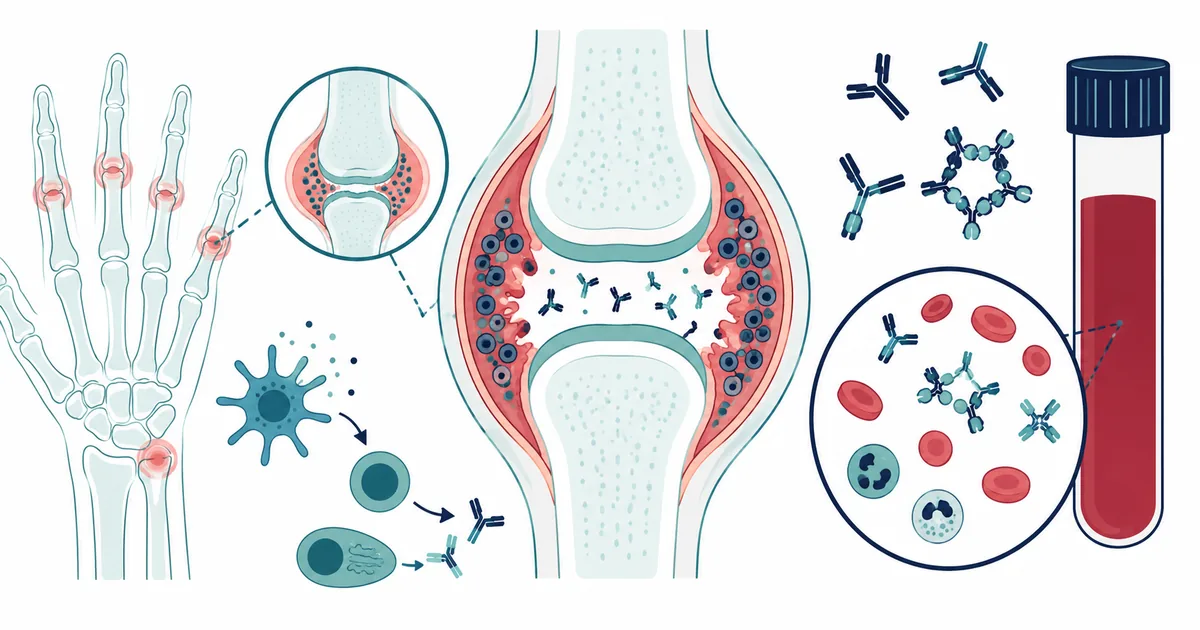
Rheumatoid arthritis, often shortened to RA, is an autoimmune inflammatory joint condition. Blood tests can help support the investigation and monitoring of RA, but they do not diagnose the condition alone.
Healthcare professionals usually consider:
- Symptoms
- Joint examination
- Duration and pattern of joint swelling
- Blood tests
- Imaging such as ultrasound or X-ray
- Other possible causes of joint pain
This page explains the most common blood tests used in rheumatoid arthritis workups: rheumatoid factor, anti-CCP, ESR, CRP and supporting tests.
Why blood tests are used in RA
Blood tests may help clinicians answer several questions:
| Question | Tests that may help |
|---|---|
| Is there inflammation? | ESR, CRP |
| Are RA-associated antibodies present? | Rheumatoid factor, anti-CCP |
| Are there anaemia or blood-count changes? | Full blood count |
| Is treatment monitoring needed? | FBC, liver function, kidney function depending on medication |
| Could another condition explain symptoms? | ANA, uric acid, infection-related tests or others depending on context |
A normal blood test does not always rule out RA, and a positive antibody test does not automatically confirm RA.
Rheumatoid factor
Rheumatoid factor, or RF, is an antibody that can be found in some people with rheumatoid arthritis.
RF can support an RA diagnosis when symptoms fit, but it is not specific to RA. It may also be found in:
- Other autoimmune conditions
- Chronic infections
- Some healthy people, especially with age
- Other inflammatory states
This means RF must be interpreted carefully. A positive RF alone is not enough to diagnose RA.
Anti-CCP antibodies
Anti-CCP stands for anti-cyclic citrullinated peptide antibodies. These antibodies are more specific for rheumatoid arthritis than rheumatoid factor in many clinical settings.
Anti-CCP may be useful because:
- It can support RA diagnosis when symptoms fit
- It may appear early in disease
- It may be linked with higher risk of erosive disease in some patients
However, anti-CCP is still not interpreted alone. A person can have RA with a negative anti-CCP, and a positive anti-CCP needs clinical context.
ESR
ESR, or erythrocyte sedimentation rate, is a non-specific inflammation marker. It measures how quickly red blood cells settle in a tube over a set time.
In RA, ESR may rise when inflammation is active. However, ESR can also rise with infection, age, anaemia, pregnancy, kidney disease and many other conditions.
ESR is useful as part of the picture, especially when tracking inflammation over time.
CRP
C-reactive protein, or CRP, is another inflammation marker. It may rise when inflammation is active.
Compared with ESR, CRP can change more quickly in response to inflammation. Clinicians may use CRP to help assess disease activity or response to treatment, but it is still non-specific.
Full blood count
A full blood count may be ordered in RA assessment or monitoring.
It can show:
| Marker | Why it may matter |
|---|---|
| Haemoglobin | Anaemia can occur with chronic inflammation or other causes |
| White blood cells | May reflect infection, inflammation or medication effects |
| Platelets | May rise with inflammation or change with treatment |
| Red cell indices | Help distinguish anaemia patterns |
FBC is also important when monitoring some RA medicines because treatment can affect blood counts.
Liver and kidney function tests
Liver and kidney function tests may be used before and during certain RA treatments. They help clinicians check whether medicines are safe and whether monitoring is needed.
These tests are not diagnostic for RA, but they are important in management and medication safety.
ANA and other autoimmune tests
An ANA test may be ordered if clinicians are considering lupus or another connective tissue disease. ANA is not a specific RA test.
Other tests may be ordered depending on the symptoms, such as:
- Uric acid if gout is considered
- Infection tests if symptoms suggest infection
- HLA-B27 in some inflammatory back or joint patterns
- Thyroid or coeliac tests in selected contexts
Seropositive and seronegative RA
You may hear the terms seropositive and seronegative RA.
| Term | Meaning |
|---|---|
| Seropositive RA | RF and/or anti-CCP is positive |
| Seronegative RA | RF and anti-CCP are negative, but clinical features may still support RA |
Seronegative RA can still be real. Negative antibodies do not automatically rule out RA.
Why one blood test is not enough
RA is a clinical diagnosis supported by laboratory and imaging findings. Blood tests are pieces of evidence, not the whole answer.
A clinician may consider:
- Which joints are affected
- Whether swelling is present
- Morning stiffness
- Symmetry of symptoms
- Duration of symptoms
- Blood test pattern
- Imaging findings
- Family and autoimmune history
- Response over time
Summary
Rheumatoid arthritis blood tests commonly include RF, anti-CCP, ESR, CRP and full blood count. These tests can support diagnosis and monitoring, but none of them confirms or rules out RA alone.
FAQ
What blood tests are used for rheumatoid arthritis?
Common tests include rheumatoid factor, anti-CCP antibodies, ESR, CRP and full blood count.
Is anti-CCP more specific than rheumatoid factor?
Anti-CCP is generally considered more specific for RA than rheumatoid factor, but it still needs clinical context.
Can you have rheumatoid arthritis with normal blood tests?
Yes. Some people have seronegative RA, where RF and anti-CCP are negative.
Does high CRP mean rheumatoid arthritis?
No. CRP is a general inflammation marker and can rise in many conditions.
Why are liver and kidney tests used in RA?
They may be used before and during treatment to monitor medication safety.
Educational only. Rheumatoid arthritis cannot be diagnosed or ruled out from blood tests alone.
Related tests and reading
- ESR — a general inflammation marker used alongside RF and anti-CCP. See: ESR Blood Test Explained
- CRP — faster-changing inflammation marker, often tracked alongside ESR in RA monitoring. See: CRP Blood Test Explained
- Full blood count — checked for anaemia of chronic disease, common in active RA. See: Full Blood Count Explained
- Lupus blood tests — another autoimmune panel with overlapping markers. See: Lupus Blood Tests Explained
More questions answered
Can you have rheumatoid arthritis with negative rheumatoid factor and anti-CCP tests?
Yes. Some people with rheumatoid arthritis do not have detectable rheumatoid factor or anti-CCP antibodies, particularly at certain stages of disease. This is sometimes described as seronegative rheumatoid arthritis, although the term relates to antibody results rather than being a separate blood test. Negative antibody tests therefore do not automatically rule out rheumatoid arthritis. Clinicians consider the pattern of joint symptoms, examination findings, inflammation markers and imaging alongside laboratory results.
Why is a full blood count done in rheumatoid arthritis?
A full blood count can provide supporting information during the investigation or monitoring of rheumatoid arthritis. Chronic inflammation may be associated with changes such as anaemia, while white blood cell and platelet counts can provide additional information about inflammation, infection or other conditions. Blood-count changes are not specific to rheumatoid arthritis and can have many different causes. The test may also form part of laboratory monitoring when certain treatments are being used.
Why are liver and kidney tests sometimes monitored in rheumatoid arthritis?
Liver function and kidney function tests may be checked because some medicines used in rheumatoid arthritis require laboratory monitoring. These tests can help clinicians identify changes in organ function during treatment and decide whether further assessment is needed. Abnormal results are not automatically caused by rheumatoid arthritis or its treatment because many other factors can affect them. Patients should follow the monitoring plan provided by their healthcare team.