
⚕️ Educational content only. This article explains what C-reactive protein (CRP) is and what a CRP test result generally means. It is not medical advice. If you have received a CRP result, speak with your doctor or healthcare provider.
Key Takeaways
- CRP is a protein made by the liver that rises rapidly in response to inflammation, infection, or tissue injury.
- A standard CRP test detects acute inflammation; a high-sensitivity CRP (hs-CRP) test measures lower-level, chronic inflammation linked to cardiovascular risk.
- CRP is not a diagnostic test on its own — it confirms inflammation is present but does not identify the cause.
- Results must be interpreted alongside symptoms, history, and other tests.
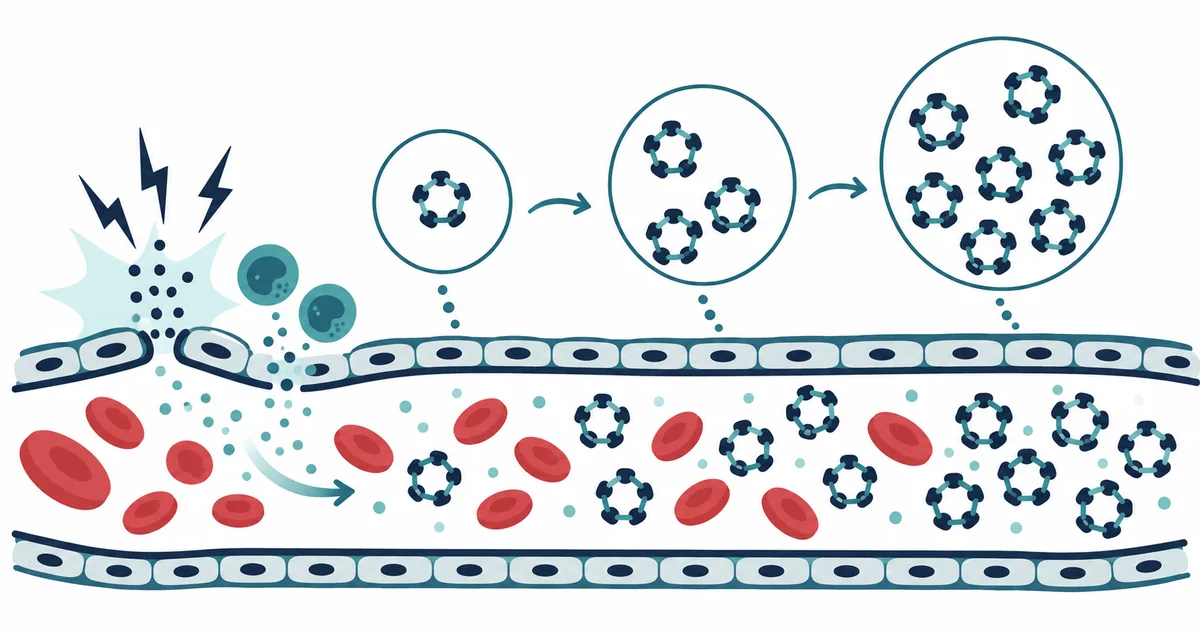
C-reactive protein (CRP) is a protein produced by the liver in response to inflammation. Measuring it in the blood is a quick and reliable way to detect the presence of significant inflammation, infection, or tissue damage in the body. CRP is one of the most commonly ordered inflammatory markers in clinical medicine.
What Is CRP?
CRP is part of the innate immune system — the body’s first-line defence against infection and injury. It is classified as an acute phase reactant, meaning its blood level changes significantly in response to acute physiological stress. When tissues are damaged or infected, immune cells release signalling molecules (particularly interleukin-6) that trigger the liver to produce CRP rapidly. Levels can rise from near zero to over 100 mg/L within 24–48 hours of an acute event.
CRP binds to damaged cells and certain pathogens, helping to activate the complement system — a cascade of proteins that assists in destroying foreign or damaged material. This makes CRP both a marker of inflammation and an active participant in the immune response.
Standard CRP vs High-Sensitivity CRP
There are two main types of CRP test, which measure the same molecule but at different levels of precision.
Standard CRP is designed to detect significant, acute inflammation. It is typically reported in mg/L and is most useful when infection, autoimmune flare, or tissue injury is suspected. Most laboratories report a normal range of below 5–10 mg/L for standard CRP.
High-sensitivity CRP (hs-CRP) uses a more precise assay to detect much smaller elevations in CRP — in the range of 0.5–10 mg/L. It is used primarily to assess cardiovascular risk in otherwise healthy individuals. Research has shown that even mildly elevated hs-CRP is associated with a higher risk of heart attack and stroke, independent of cholesterol levels.
What Does a CRP Result Mean?
CRP results must always be interpreted in context. The same numerical result can mean different things depending on the clinical situation.
Standard CRP Levels (Approximate)
| CRP Level (mg/L) | General Interpretation |
|---|---|
| Below 5 | Normal — no significant acute inflammation detected |
| 5–20 | Mild to moderate elevation — may indicate minor infection, inflammatory condition, or recent tissue injury |
| 20–100 | Significant elevation — often seen with bacterial infection, autoimmune flares, or significant tissue damage |
| Above 100 | Marked elevation — strongly suggestive of serious bacterial infection or major tissue injury |
These ranges are approximate. Different laboratories may use slightly different reference ranges, and results should always be considered alongside clinical findings. To understand how reference ranges work more broadly, see our guide to reference ranges for blood tests.
hs-CRP Levels and Cardiovascular Risk
| hs-CRP Level (mg/L) | Cardiovascular Risk Category |
|---|---|
| Below 1.0 | Lower risk |
| 1.0–3.0 | Intermediate risk |
| Above 3.0 | Higher risk |
These categories are used alongside other cardiovascular risk factors such as cholesterol, blood pressure, and family history — not in isolation. For a broader picture of cardiovascular testing, see our guide to the cholesterol blood test.
What Can Cause an Elevated CRP?
Many different conditions can raise CRP. The test indicates that inflammation is present but cannot identify where or why. Common causes include:
- Bacterial infections — CRP rises sharply with bacterial infection and tends to be higher than in viral illness
- Viral infections — typically cause a smaller CRP elevation than bacterial infections
- Autoimmune and inflammatory conditions — such as rheumatoid arthritis, lupus, and inflammatory bowel disease
- Tissue injury — including trauma, surgery, burns, and heart attack
- Chronic conditions — including obesity, type 2 diabetes, and cardiovascular disease (particularly relevant for hs-CRP)
- Malignancy — some cancers produce an inflammatory response that raises CRP
A normal or low CRP makes significant acute inflammation unlikely but does not rule out all disease.
How Is CRP Used Clinically?
CRP is used across a wide range of clinical scenarios. Its rapid rise and fall in response to inflammation makes it useful for monitoring as well as initial assessment.
Detecting infection: A significantly raised CRP in a patient with fever and other symptoms helps support a diagnosis of bacterial infection and may guide decisions about antibiotic treatment.
Monitoring inflammatory conditions: In conditions such as rheumatoid arthritis or Crohn’s disease, serial CRP measurements track whether inflammation is improving or worsening, and whether treatment is working.
Post-surgical monitoring: CRP normally rises after surgery (due to tissue trauma) and then falls. A secondary rise after initial improvement can suggest a surgical complication such as wound infection or anastomotic leak.
Cardiovascular risk assessment: hs-CRP is used alongside lipid panels (including the cholesterol blood test) to refine cardiovascular risk, particularly in individuals at intermediate risk where clinical decision-making is uncertain.
CRP Alongside Other Tests
CRP is rarely interpreted alone. It is commonly ordered as part of a broader panel. Relevant companion tests include:
- Full blood count (FBC) — elevated white blood cells may support infection; low platelets can suggest sepsis
- Erythrocyte sedimentation rate (ESR) — another inflammation marker, slower to rise and fall than CRP
- Procalcitonin — more specific for bacterial infection than CRP
- Blood cultures — to identify the causative organism in suspected infection
Limitations of CRP
CRP is a sensitive but non-specific marker. It tells you inflammation is happening but not the cause, location, or severity of the underlying condition. Some important limitations:
- CRP does not distinguish between infection, autoimmune disease, cancer, or tissue injury
- Some serious conditions (including certain viral infections) may cause only a modest CRP rise
- CRP can be normal early in the course of an infection before levels have had time to rise
- Chronic low-grade inflammation (as measured by hs-CRP) is associated with risk but does not establish causation
More questions answered
What can the CRP blood test tell you, and what can it not tell you?
The CRP blood test provides information about the concentration of C-reactive protein, an acute-phase protein. It can provide a non-specific marker of inflammatory activity, but it usually cannot identify the exact cause of an abnormal value by itself. The result becomes more useful when combined with ESR, full blood count and clinical findings and the reason the test was requested. The main limitation is that one laboratory measurement is only part of the wider clinical picture.
Why are other blood tests often ordered with the CRP blood test?
Related tests can show whether a change in the CRP blood test fits a broader laboratory pattern. Measurements such as ESR, full blood count and clinical findings may assess connected organs, pathways or biological processes. This can help clinicians distinguish between several possible explanations for the same result. The tests are therefore complementary rather than interchangeable.
Can medicines or supplements affect the CRP blood test?
Yes, some medicines or supplements can influence the CRP blood test directly or indirectly, although the effect depends on the specific substance and assay. Other influences include infection, inflammation, tissue injury and other acute-phase responses, so medication is only one possible explanation for a change. Patients should not stop prescribed treatment just to alter a laboratory result unless a healthcare professional has specifically instructed them to do so. Medication information should be shared with the healthcare team interpreting the result.
Why might a healthcare professional request another CRP blood test?
A second CRP blood test may be used to confirm an unexpected result, check a trend or see whether a temporary change has resolved. Repeating the test can also help when the first specimen had a quality problem or when monitoring requires measurements at different times. A repeat value is interpreted alongside the earlier result rather than treated as an unrelated number. The need for retesting depends on the clinical question.
Why might my CRP blood test result be flagged at one laboratory but not another?
Laboratories can use different reference intervals or decision limits because methods, instruments, reagents and populations differ. A value near a boundary may therefore be flagged differently even when the numerical results are similar. This does not automatically mean that one laboratory made an error. Always use the range printed on the same report as the result being interpreted.
Can my CRP blood test result change even when I feel the same?
Yes. Laboratory values can change because of normal biological variation, early physiological changes, medicines, hydration, timing or other factors before noticeable symptoms occur. Feeling well also does not guarantee that every laboratory measurement will sit inside its reference interval. The importance of a change depends on its size, persistence and clinical context. Personal results should be discussed with a healthcare professional when interpretation is needed.
Does a normal CRP blood test rule out every related condition?
No. A result inside the reference interval does not exclude every condition related to the biological system being tested. Some disorders may not affect the marker, may affect it only at certain stages or may require other tests to detect. Clinicians therefore consider symptoms, examination and related investigations rather than using one normal value as a universal rule-out. The CRP blood test should be interpreted according to the purpose for which it was ordered.
ESR vs CRP vs Procalcitonin: Which Inflammation Marker Does Your Doctor Use and Why?
Acute vs Chronic Inflammation: What’s the Difference and How Are They Tested?