
⚕️ Educational content only. This article explains what thyroid function tests measure and what the results generally indicate. It is not medical advice. Speak with your doctor or healthcare provider for interpretation in the context of your personal health.
Thyroid function tests are blood tests that measure how well the thyroid gland is producing hormones. The thyroid is a butterfly-shaped gland in the neck that regulates metabolism, energy levels, heart rate, and body temperature. Thyroid disorders are among the most common endocrine conditions worldwide, making thyroid function tests some of the most frequently requested blood tests in both primary and specialist care.
Key Takeaways
- TSH (thyroid-stimulating hormone) is the primary screening test — produced by the pituitary gland, not the thyroid.
- A raised TSH suggests underactive thyroid (hypothyroidism); a suppressed TSH suggests overactive thyroid (hyperthyroidism).
- Free T4 is the main thyroid hormone measured alongside TSH to confirm and characterise thyroid disorders.
- Free T3 is the biologically active form; measured selectively in specific clinical situations.
- Typical TSH reference range: 0.4–4.0 mU/L — but always interpreted in clinical context.
How the Thyroid Hormone System Works
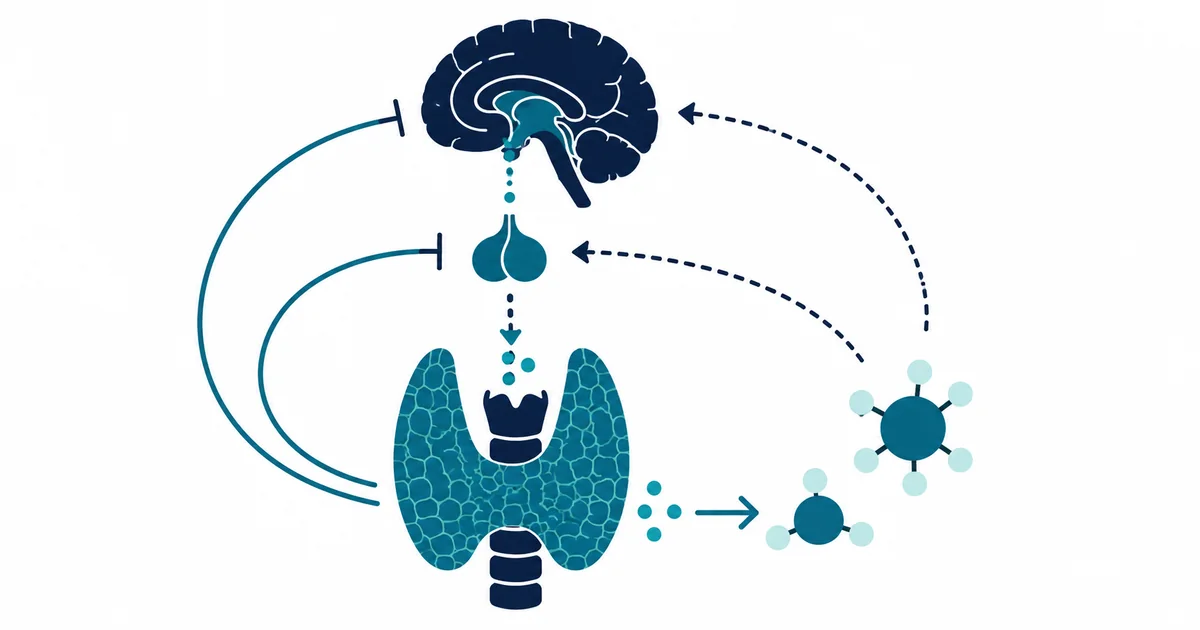
The thyroid hormone system operates as a feedback loop — the hypothalamic-pituitary-thyroid (HPT) axis. The hypothalamus releases TRH, which signals the pituitary to release TSH. TSH stimulates the thyroid to produce T4 and T3. When levels are adequate, they feed back to suppress further TSH production. When the thyroid underperforms, TSH rises to compensate. When the thyroid overperforms, TSH falls. This inverse relationship makes TSH a sensitive and reliable indicator of thyroid function.
TSH (Thyroid-Stimulating Hormone)
TSH is the first-line test for thyroid disorders. It becomes abnormal before free T4 or T3 change significantly, making it the most sensitive screening marker. Typical reference range: 0.4–4.0 mU/L (varies by laboratory). A raised TSH indicates the thyroid is not producing enough hormone — consistent with hypothyroidism. A suppressed TSH indicates overproduction — consistent with hyperthyroidism or overtreatment with thyroid medication.
Free T4 (Thyroxine)
T4 is the main hormone secreted by the thyroid. Most T4 is bound to carrier proteins and inactive; free T4 (fT4) is the small unbound fraction that is biologically active. Measuring free T4 rather than total T4 avoids interference from changes in carrier protein levels (e.g., in pregnancy or liver disease). Free T4 is measured alongside TSH to characterise thyroid disorders: in primary hypothyroidism, TSH is high and free T4 is low; in primary hyperthyroidism, TSH is suppressed and free T4 is elevated; in secondary (pituitary) hypothyroidism, both TSH and free T4 may be low. Typical reference range: 12–22 pmol/L.
Free T3 (Triiodothyronine)
T3 is the biologically active thyroid hormone. Most T3 is produced by conversion of T4 in peripheral tissues. Free T3 is not routinely measured alongside TSH and T4, but is useful when TSH is suppressed but free T4 is normal (T3 toxicosis), in monitoring known thyroid disease, and in assessing non-thyroidal illness where T3 may be low despite normal thyroid function. Typical reference range: 3.1–6.8 pmol/L.
Common Result Patterns
High TSH, low free T4: primary hypothyroidism. High TSH, normal free T4: subclinical hypothyroidism. Low TSH, high free T4/T3: primary hyperthyroidism. Low TSH, normal free T4: subclinical hyperthyroidism. Low TSH and low free T4 together: possible secondary (pituitary) hypothyroidism — requires specialist assessment.
Common Thyroid Conditions
Hypothyroidism is most commonly caused by Hashimoto’s thyroiditis (autoimmune thyroid destruction). Symptoms include fatigue, weight gain, cold intolerance, constipation, and low mood. Treatment is levothyroxine (synthetic T4), with TSH monitored to adjust dosing. Hyperthyroidism is most commonly caused by Graves’ disease (autoimmune stimulation of TSH receptors). Symptoms include weight loss, palpitations, heat intolerance, and tremor. Treatment options include antithyroid drugs, radioiodine, or surgery.
Factors That Can Affect Results
High-dose biotin (vitamin B7) supplements interfere with many immunoassay-based thyroid tests and should be stopped 48–72 hours before testing. Medications including amiodarone, lithium, glucocorticoids, and some cancer immunotherapies affect thyroid hormone levels. Pregnancy changes TSH reference ranges in each trimester. Non-thyroidal illness (sick euthyroid syndrome) can suppress T3 without true thyroid disease.
References
- National Library of Medicine. Thyroid Function Tests. MedlinePlus. https://medlineplus.gov/lab-tests/thyroid-function-tests/
- NHS. Underactive thyroid (hypothyroidism). https://www.nhs.uk/conditions/underactive-thyroid-hypothyroidism/
- NICE Guideline NG145. Thyroid disease: assessment and management. 2019.
- Ross DS et al. 2016 American Thyroid Association guidelines for hyperthyroidism. Thyroid. 2016;26(10):1343–1421.
- Garber JR et al. Clinical practice guidelines for hypothyroidism in adults. Thyroid. 2012;22(12):1200–1235.
More questions answered
What type of sample is used for the thyroid function test panel?
The thyroid function test panel is commonly performed using serum or plasma, although laboratories may specify a particular tube, container or processing method. Correct collection matters because the analytical method is validated for defined specimen conditions. A wrong or poorly handled specimen can produce unreliable results or be rejected. The collection instructions from the testing laboratory should therefore be followed.
What happens to the sample before the thyroid function test panel is analysed?
Before analysis, the laboratory confirms patient and specimen identification and checks whether the sample meets acceptance criteria. The specimen may then be centrifuged, separated, mixed or otherwise prepared according to the test method. These pre-analytical steps are controlled because they can affect the final result before the analyser even begins measuring. Unsuitable samples are managed according to laboratory procedure.
What is the laboratory actually measuring in the thyroid function test panel?
The thyroid function test panel is designed to determine hormones involved in the pituitary-thyroid feedback system. Laboratories use validated hormone immunoassays so that the analytical signal or observation can be converted into a reportable result. The exact chemistry, optical signal, timing step or detection system varies by test and manufacturer. Students should separate the biological or analytical target from the technology used to measure it.
How does quality control help make the thyroid function test panel reliable?
Laboratories run quality-control material to check whether the analytical system is performing within accepted limits. Results are assessed using defined rules before patient testing is trusted, and problems can trigger investigation or recalibration. Laboratories may also participate in external quality assessment to compare performance with other services. These systems reduce avoidable analytical error but do not remove normal biological variation.
Why can the thyroid function test panel use different methods or units between laboratories?
Different laboratories may use different analytical platforms, reagents or calibration systems for the thyroid function test panel. Some tests can therefore have method-specific units, cut-offs or reference intervals even when they assess the same biological target. Direct comparison is safest when the method and units are compatible. The range and units printed on the reporting laboratory’s result should be used.
Why are previous thyroid function test panel results useful?
Previous thyroid function test panel results provide a personal trend that can show whether the value is stable, gradually changing or different from the person’s earlier pattern. A trend can sometimes be more informative than comparing one result only with a population reference interval. Changes still need to be considered alongside method changes, timing and clinical context. Where possible, comparable methods make longitudinal interpretation easier.
What should students remember when interpreting the thyroid function test panel?
Students should first identify what the test measures, then check the specimen, method, units and reference information. Next, consider illness, pregnancy, medicines, assay interference and pituitary or thyroid conditions and how TSH, free T4 and selected additional thyroid tests might change the interpretation. A laboratory value should not be converted directly into a diagnosis without context. This stepwise approach connects analytical science with safe result interpretation.