
⚕️ Educational content only. This article explains what kidney function tests measure and what the results generally indicate. It is not medical advice. If you have received kidney function test results, speak with your doctor or healthcare provider for interpretation in the context of your personal health.
Kidney function tests — also called renal function tests or a renal panel — are blood and sometimes urine tests that assess how well the kidneys are filtering waste from the blood and maintaining the body’s fluid and electrolyte balance. They are among the most frequently requested tests in routine healthcare, used for monitoring chronic conditions such as hypertension and diabetes, as well as investigating symptoms such as swelling, fatigue, or changes in urination.
Key Takeaways
- Kidney function tests typically include creatinine, eGFR, urea (BUN), and electrolytes such as sodium, potassium, and bicarbonate.
- Creatinine is a waste product of muscle metabolism; elevated levels suggest reduced kidney filtration.
- eGFR (estimated glomerular filtration rate) gives a percentage estimate of how well the kidneys are filtering blood relative to a healthy young adult.
- Urea (blood urea nitrogen, BUN) is another waste marker but is less specific than creatinine as it is influenced by diet and hydration.
- Electrolyte abnormalities (potassium, sodium, bicarbonate) often appear alongside declining kidney function.
- Early kidney disease often has no symptoms — blood tests are essential for detection.
What Are the Kidneys’ Main Jobs?
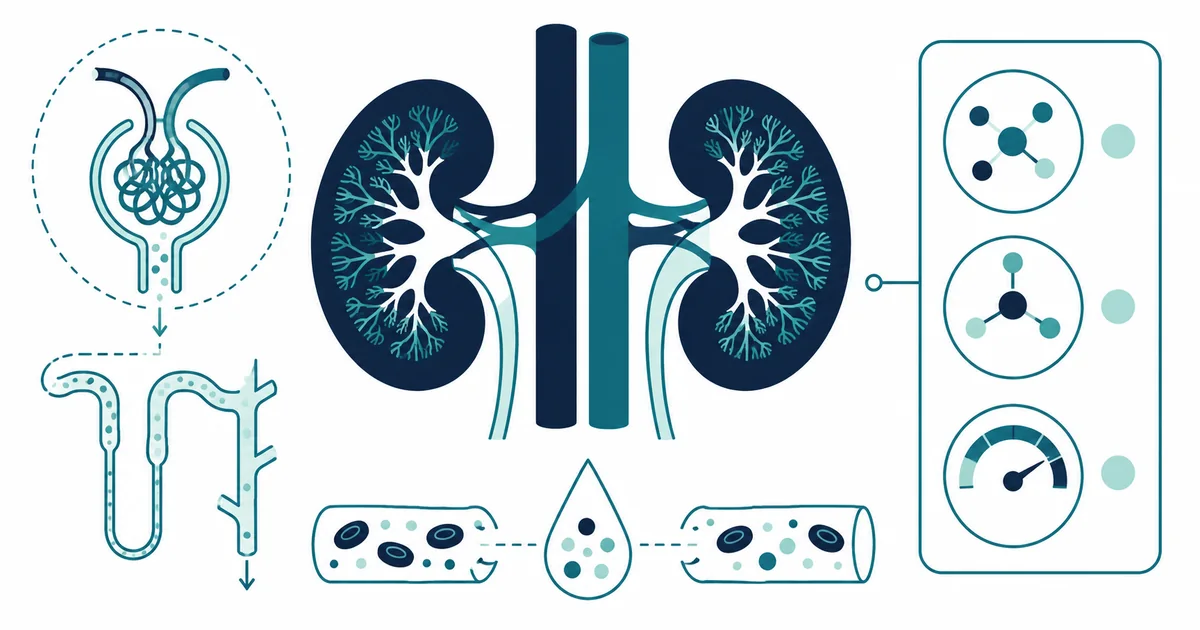
Before examining the tests, it helps to understand what the kidneys do. The kidneys are two bean-shaped organs located in the back of the abdomen. Each contains approximately one million tiny filtering units called nephrons. Their key roles include filtering waste products and excess substances from the blood into urine, regulating fluid balance, controlling blood pressure (via the renin-angiotensin-aldosterone system), maintaining electrolyte levels (sodium, potassium, calcium, phosphate, bicarbonate), producing erythropoietin (a hormone that stimulates red blood cell production), and activating vitamin D.
When the kidneys are damaged or diseased, these functions are progressively impaired — and blood tests can detect these changes, often before symptoms appear.
Creatinine
Creatinine is a breakdown product of creatine phosphate, a molecule used in muscle energy metabolism. It is produced by muscle cells at a relatively constant rate and is excreted almost entirely by the kidneys through filtration. Because production is fairly steady and excretion depends on kidney function, creatinine is one of the most reliable markers of renal filtration.
When kidney function declines, creatinine accumulates in the blood. However, the relationship is non-linear: creatinine levels may remain within the reference range until kidney function has already declined by 40–50%, because the remaining nephrons compensate. This is why eGFR is calculated alongside creatinine. Typical reference ranges: approximately 60–110 µmol/L for women, 70–120 µmol/L for men (varies by laboratory).
eGFR (Estimated Glomerular Filtration Rate)
The glomerular filtration rate (GFR) is a measure of how much blood the kidneys filter per minute. The estimated GFR (eGFR) is calculated using creatinine, age, and sex (the CKD-EPI equation is now standard in most UK and US laboratories). The result is expressed as a percentage of the expected filtration rate for a healthy young adult.
An eGFR ≥90 mL/min/1.73m² is considered normal. Chronic kidney disease (CKD) is classified across five stages based on eGFR, with Stage 1 representing normal or mildly increased function with other markers of kidney damage, down to Stage 5 (eGFR <15) indicating kidney failure. eGFR should be interpreted alongside markers of kidney damage such as proteinuria (protein in the urine). A single low eGFR reading may be due to dehydration, acute illness, or certain medications — a sustained reduction over three or more months is required to diagnose CKD.
Urea (BUN — Blood Urea Nitrogen)
Urea is produced in the liver as a result of protein metabolism — when amino acids are broken down, the nitrogen they contain is converted into urea and excreted by the kidneys. Like creatinine, urea accumulates when the kidneys are not filtering efficiently.
However, urea is less specific than creatinine as a kidney marker because it is strongly influenced by protein intake (high-protein diets raise urea), hydration status (dehydration concentrates urea), and catabolic states (e.g., fever, burns, or steroid use can increase urea production). In the UK, results are reported as urea in mmol/L (typical range: 2.5–7.8 mmol/L). In the US, results are typically reported as BUN in mg/dL (typical range: 7–20 mg/dL).
Electrolytes: Sodium, Potassium, and Bicarbonate
The kidneys regulate electrolyte levels precisely. As kidney function declines, electrolyte balance is disrupted:
Sodium (Na⁺)
Sodium is the main electrolyte controlling fluid distribution. Kidney disease can cause both hyponatraemia (low sodium, <135 mmol/L) due to water retention, and hypernatraemia (high sodium, >145 mmol/L) in dehydration states. Abnormal sodium is a common finding across many medical conditions, not just kidney disease.
Potassium (K⁺)
Potassium is excreted by the kidneys. In chronic kidney disease, the kidneys lose the ability to excrete potassium efficiently, leading to hyperkalaemia (high potassium, >5.0–5.5 mmol/L depending on laboratory). This is one of the most dangerous complications of kidney failure because elevated potassium can cause life-threatening cardiac arrhythmias. Hypokalaemia (low potassium) can also occur and is associated with vomiting, diarrhoea, and some medications.
Bicarbonate (HCO₃⁻)
The kidneys regulate blood pH by controlling bicarbonate levels. Declining kidney function impairs this buffering capacity, leading to metabolic acidosis — a fall in blood bicarbonate and pH. Typical reference range: 22–29 mmol/L. Low bicarbonate in the context of kidney disease is associated with faster disease progression.
Other Markers Sometimes Included
Depending on the clinical context, additional markers may be ordered alongside a renal panel. Phosphate is often elevated in CKD because the kidneys normally excrete phosphate; high phosphate contributes to cardiovascular disease and bone disease in CKD. Calcium may be low in CKD as a consequence of impaired vitamin D activation and elevated phosphate. Uric acid is another waste product filtered by the kidneys; elevated levels (hyperuricaemia) can cause gout and may contribute to kidney injury. Cystatin C is an alternative to creatinine for estimating GFR — particularly useful when muscle mass is unusual (very low or very high), as it is not influenced by muscle mass. Urinary albumin-to-creatinine ratio (ACR) — measured on a urine sample — detects protein leaking into urine, an important early marker of kidney damage in diabetes and hypertension.
What Causes Abnormal Kidney Function Tests?
Kidney function can be impaired by many conditions and is broadly categorised by cause: pre-renal (reduced blood flow to the kidneys, e.g., dehydration, heart failure, blood loss), renal (intrinsic kidney damage, e.g., glomerulonephritis, diabetic nephropathy, hypertensive nephrosclerosis, acute tubular necrosis), and post-renal (obstruction of urine outflow, e.g., kidney stones, enlarged prostate, tumour).
Common chronic causes of progressive kidney disease include diabetes mellitus (the leading cause of CKD in developed countries), hypertension (chronic high blood pressure damages glomerular capillaries), autoimmune conditions (such as lupus nephritis), inherited conditions (such as polycystic kidney disease), and recurrent infections or obstruction.
Interpreting Your Results: What to Expect
A single abnormal kidney function test does not necessarily mean you have kidney disease. Creatinine can be temporarily elevated with dehydration, intense exercise, certain medications (e.g., NSAIDs, ACE inhibitors, aminoglycosides), or muscle injury. eGFR decreases naturally with age — an eGFR of 60–75 in an older adult may be age-appropriate rather than indicating disease.
Your doctor will consider your results alongside your symptoms, medical history, medications, other blood and urine tests, and blood pressure. If kidney disease is suspected, a repeat test two to three months later is generally recommended before diagnosing CKD, unless the situation is acute. For more on how reference ranges work and why a result outside the range does not always indicate disease, see our article on reference ranges explained for blood tests.
References
- National Library of Medicine. Kidney Function Tests. MedlinePlus. https://https://www.nhs.uk/conditions/kidney-disease/diagnosis/
- NHS. Kidney disease — Diagnosis. https://www.nhs.uk/conditions/kidney-disease/diagnosis/
- NICE Guideline NG203. Chronic kidney disease: assessment and management. National Institute for Health and Care Excellence. 2021.
- Kidney Disease: Improving Global Outcomes (KDIGO) CKD Work Group. KDIGO 2024 clinical practice guideline for the evaluation and management of chronic kidney disease. Kidney International. 2024;105(4S):S117–S314.
- Inker LA, Eneanya ND, Coresh J, et al. New creatinine- and cystatin C–based equations to estimate GFR without race. New England Journal of Medicine. 2021;385(19):1737–1749.
- American College of Physicians (ACP). Understanding Your Kidney Tests. https://www.acponline.org
More questions answered
Why is the kidney function blood test often interpreted with other tests?
The kidney function blood test answers one specific laboratory question, while creatinine, eGFR, urea, electrolytes and urine albumin measurements can provide different information about the same clinical problem. Looking at several results together can reveal a pattern that one value cannot show. A normal or abnormal result therefore should not be separated from the rest of the laboratory picture. This combined pattern-based interpretation is one reason clinicians often order related tests together.
Can an abnormal kidney function blood test result have more than one cause?
Yes. The kidney function blood test can be affected by hydration, muscle mass, medicines, acute illness and kidney function, so an abnormal value is not specific to one condition. Different biological processes can produce similar laboratory changes even when their causes are unrelated. This is why clinical context and other test results matter before drawing conclusions. An individual abnormal result should be discussed with a healthcare professional.
Can sample quality affect the kidney function blood test?
Yes. Sample quality can influence whether the kidney function blood test is technically reliable, especially when collection, transport or processing requirements are not met. Depending on the test, problems such as haemolysis, clotting, contamination, delay or an unsuitable container may interfere with analysis. Laboratories apply specimen-acceptance rules and may add comments, repeat testing or request recollection when necessary. These checks are part of the laboratory’s quality system.
Why might the kidney function blood test be different when it is repeated?
A repeat kidney function blood test can differ because the underlying biology has changed, because of normal biological variation or because the first sample was affected by a temporary factor. Analytical systems also have small amounts of measurement variation, even when they are working correctly. Looking at a series of results helps distinguish a persistent trend from an isolated change. Clinicians therefore interpret trends over time rather than expecting every repeat value to be identical.
Does fasting or timing matter for the kidney function blood test?
Fasting or timing may matter for some laboratory requests, but it is not a universal requirement for every kidney function blood test. Preparation depends on the exact test request, so the laboratory or healthcare service should provide any fasting or timing instructions. Other tests collected at the same appointment may also determine how the blood sample should be prepared. The practical approach is to follow the laboratory’s specific collection instructions rather than using a generic fasting rule.
What does the laboratory do if a kidney function blood test result looks unexpected?
An unexpected kidney function blood test result may trigger automated rules or manual review before it is released. Laboratory staff can check the specimen, previous results, analyser flags and quality-control data to look for technical explanations. Depending on the method, the sample may be repeated, diluted, confirmed or investigated with another procedure. The goal is to make sure the reported value meets the laboratory’s validation criteria.
What are the main limitations of the kidney function blood test?
The kidney function blood test measures markers that reflect filtration, fluid balance and electrolyte handling, but that does not mean it can explain the cause of every abnormal result. The test can support assessment and monitoring of kidney function, yet interpretation still depends on other evidence such as related laboratory tests, clinical findings or imaging where relevant. Method limitations and biological variation can also affect the result. A useful takeaway is that the test is a piece of evidence, not a diagnosis by itself.
Creatinine vs eGFR: What’s the Difference and What Do Your Results Mean?