
⚕️ Educational content only. This article provides a scientific overview of the immune system for biomedical science students. It is not medical advice.
The immune system is the body’s defence against infection, foreign substances, and malignant cells. It comprises a complex network of cells, proteins, and organs that work together to recognise and eliminate pathogens while tolerating the body’s own tissues. Understanding immunology is fundamental to biomedical science, underpinning disciplines from haematology to microbiology to clinical biochemistry.
Key Takeaways
- The innate immune system provides rapid, non-specific defence; the adaptive immune system provides slower, antigen-specific, memory-forming responses.
- Key innate cells: neutrophils, macrophages, dendritic cells, NK cells, mast cells. Key adaptive cells: T lymphocytes and B lymphocytes.
- Antibodies (immunoglobulins) are produced by plasma cells (differentiated B cells) and mediate humoral immunity.
- Laboratory tests assess immune function via FBC and differential, immunoglobulin levels, lymphocyte subset analysis, and complement testing.
Innate Immunity: The First Line of Defence
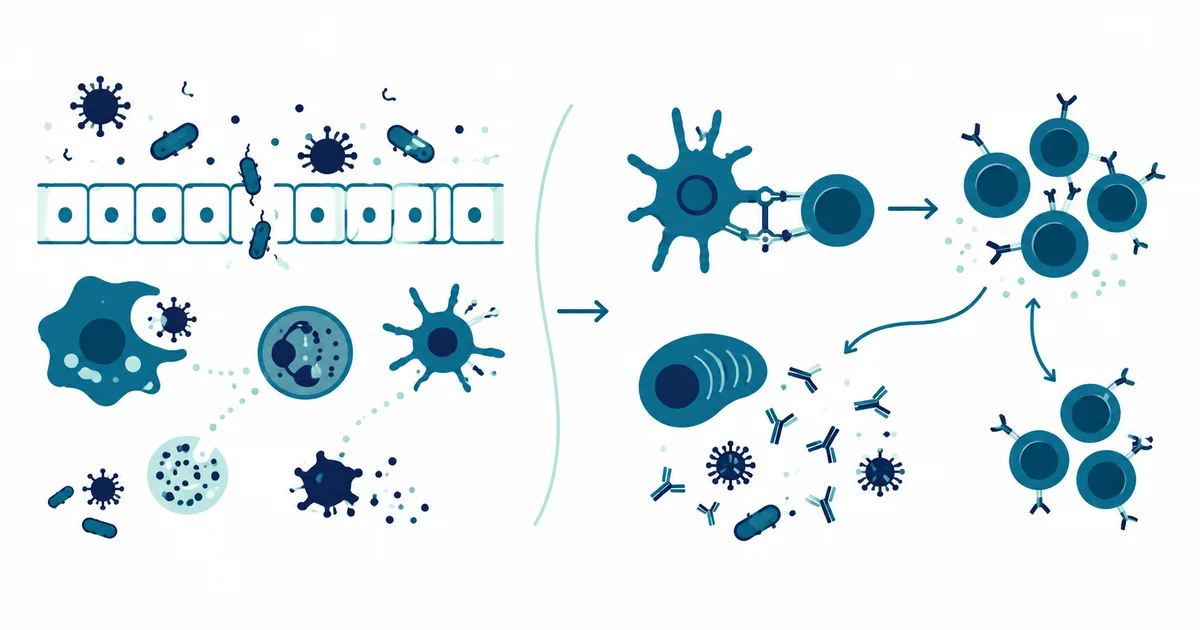
The innate immune system provides immediate, non-specific protection. Physical barriers (skin, mucous membranes, cilia) prevent pathogen entry. When breached, pattern recognition receptors (PRRs) — including Toll-like receptors (TLRs) and NOD-like receptors — recognise conserved microbial structures called pathogen-associated molecular patterns (PAMPs). This triggers inflammation, phagocytosis, and the release of cytokines and chemokines. Key innate cells include: neutrophils (first responders, phagocytic, short-lived); macrophages (phagocytic, antigen-presenting, long-lived tissue residents); dendritic cells (bridge between innate and adaptive immunity via antigen presentation); natural killer (NK) cells (kill virally infected and tumour cells without prior sensitisation); and mast cells and basophils (mediators of allergy and parasitic defence via IgE-mediated degranulation).
Adaptive Immunity: Specificity and Memory
The adaptive immune system activates 4–7 days after initial antigen exposure and generates immunological memory. It involves two major branches: humoral immunity (B cells → plasma cells → antibody production) and cell-mediated immunity (T cells → cytotoxic T cells, helper T cells). Antigen-presenting cells (APCs) display antigen fragments on MHC molecules: MHC class I (on all nucleated cells) presents intracellular peptides to CD8+ cytotoxic T cells; MHC class II (on APCs) presents extracellular antigens to CD4+ helper T cells. CD4+ T helper cells coordinate the immune response through cytokine secretion, activating B cells (Th2), macrophages (Th1), and supporting CD8+ T cell responses.
Immunoglobulins (Antibodies)
Antibodies are glycoproteins produced by plasma cells. They have a Y-shaped structure with two heavy chains and two light chains, with variable regions forming the antigen-binding site (Fab) and a constant region (Fc) that mediates effector functions. The five main isotypes are IgG (most abundant in serum; crosses placenta), IgA (found in secretions; mucosal defence), IgM (first produced in primary response; pentameric), IgE (mediates allergy and anti-parasitic responses), and IgD (B cell receptor; low serum concentration). Serum immunoglobulin levels (IgG, IgA, IgM) are measured clinically to detect immunodeficiency or overproduction (as in myeloma).
Complement System
Complement is a cascade of serum proteins that amplify immune responses. Three pathways (classical, lectin, and alternative) converge at C3 cleavage, producing C3b (opsonisation), C3a and C5a (anaphylatoxins), and the membrane attack complex (MAC, C5b-9) which lyses bacteria. Complement deficiencies increase susceptibility to encapsulated organisms (C3 deficiency) or Neisseria species (terminal complement deficiency). CH50 and AP50 assays assess classical and alternative pathway function respectively; individual component levels (C3, C4) are measured in clinical immunology.
References
- Janeway CA Jr, et al. Immunobiology: The Immune System in Health and Disease. 9th ed. Garland Science; 2022.
- NIH National Institute of Allergy and Infectious Diseases. Overview of the Immune System. niaid.nih.gov
- Abbas AK, Lichtman AH, Pillai S. Cellular and Molecular Immunology. 10th ed. Elsevier; 2022.
More questions answered
What is the difference between innate and adaptive immunity?
Innate immunity provides rapid, broad defence using barriers, phagocytic cells and other immediate responses. Adaptive immunity develops more specific responses through B cells, T cells and antibodies after recognising particular targets. The two systems communicate closely rather than working as separate layers. This cooperation helps the body respond quickly while also developing more targeted immune memory.
What do B cells and T cells do differently?
B cells can develop into antibody-producing plasma cells and memory cells after appropriate activation. T cells include several functional groups that can coordinate immune responses or directly target infected and abnormal cells. Both are part of adaptive immunity, but they recognise and respond to threats in different ways. Their activity is controlled by complex signalling so that immune responses are effective without causing unnecessary damage.
What are antibodies and what do they actually do?
Antibodies are proteins produced by plasma cells that bind specific molecular targets called antigens. Binding can help neutralise a target, block its interaction with cells or mark it for other parts of the immune system to remove. Different antibody classes have different biological roles and locations in the body. Detecting antibodies in the laboratory can provide useful information, but the meaning depends on the particular test and clinical context.
Why does inflammation happen during an immune response?
Inflammation is a coordinated response that helps immune cells and signalling molecules reach an area of injury or infection. Blood vessels, immune cells and chemical mediators change their behaviour as part of that process. Inflammation can be protective, but excessive or persistent immune activation can also contribute to tissue damage. Laboratory markers such as CRP may reflect inflammatory activity but do not identify the cause by themselves.
What is immune memory?
Immune memory is the ability of parts of the adaptive immune system to respond more efficiently after recognising a previously encountered antigen. Memory B cells, memory T cells and long-lived antibody-producing cells can contribute to this faster response. This principle underlies much of the protection created by vaccination as well as immunity after some infections. The strength and duration of memory vary depending on the antigen and the type of immune response.
Why can the immune system attack the body’s own tissues?
Normally, immune tolerance helps prevent strong responses against the body’s own molecules. Autoimmune disease can develop when parts of this control system fail and immune cells or autoantibodies react against self-antigens. Genetics, environmental triggers and immune regulation can all contribute, depending on the condition. A positive autoimmune laboratory marker does not by itself prove that an autoimmune disease is present.
How do laboratories test the immune system?
Laboratories can examine the immune system using immunoassays, antibody tests and flow cytometry as well as measurements of complement proteins or immunoglobulins. Different methods assess different parts of immune function rather than providing one overall immune score. Results are interpreted with clinical context because abnormal values can have several explanations. A healthcare professional should interpret individual immune-test results.
T Cells vs B Cells: What’s the Difference and How Are They Tested?