
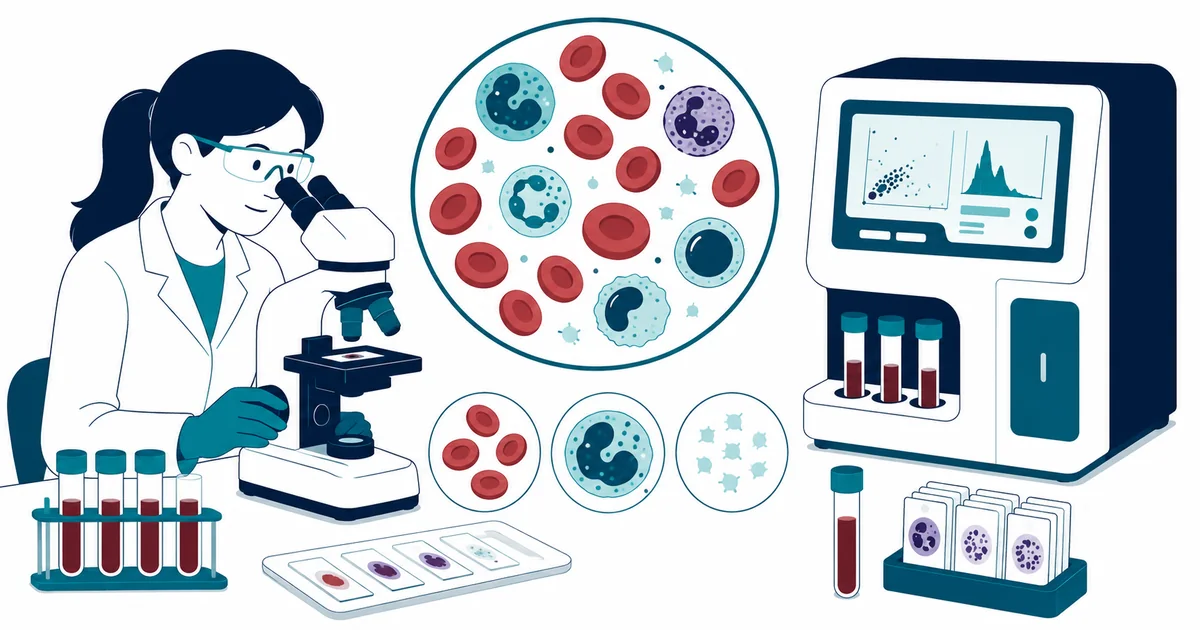
Hematology is the branch of laboratory medicine that studies blood, blood cells, bone marrow, clotting, and blood-related disorders. In UK spelling, it is often written as haematology. If you have ever had a full blood count, platelet count, blood film, reticulocyte count, ESR, PT, INR, APTT, or anaemia investigation, you have already met hematology in practice.
For patients, hematology often appears as a blood test report filled with terms such as haemoglobin, white blood cells, neutrophils, lymphocytes, platelets, MCV, and red cell count. For biomedical science students, hematology is a core laboratory discipline that connects cell biology, microscopy, automation, morphology, coagulation, transfusion science, and clinical interpretation. For laboratory professionals, it is a busy, safety-critical department where automated results, manual review, quality control, and urgent communication all matter.
The most important thing to understand is that hematology results are not a diagnosis by themselves. They are laboratory clues. Healthcare professionals interpret them alongside symptoms, medical history, examination findings, medication use, previous results, and other tests.
Hematology in simple terms
Hematology is the study of blood and the tissues that produce blood cells. Blood may look like a simple red fluid, but it contains several important components: red blood cells, which carry oxygen; white blood cells, which are involved in immune defence; platelets, which help blood clot; plasma, the liquid part of blood; clotting proteins, which help control bleeding; and haemoglobin, the oxygen-carrying protein inside red blood cells.
A hematology laboratory measures and examines these components. Some tests count blood cells. Some assess their size and shape. Some look at clotting function. Some use microscopy to review the appearance of cells. Some support investigations into anaemia, infection, inflammation, bleeding, clotting, blood cancers, inherited blood conditions, or treatment monitoring.
MedlinePlus describes a complete blood count, or CBC, as a group of tests that measure the number and size of different blood cells, including red blood cells, white blood cells, platelets, haemoglobin, haematocrit, and mean corpuscular volume.
That makes the full blood count one of the most familiar entry points into hematology.
Hematology vs haematology
“Hematology” and “haematology” mean the same thing. The difference is spelling. Hematology is the American spelling; haematology is commonly used in British English and many Commonwealth settings. Because many people search online using “hematology,” this article uses that spelling in the title. But in UK biomedical science, hospitals and professional materials often use “haematology.”
What does a hematology lab do?
A hematology lab examines blood to help answer questions such as: Are red blood cells present in the expected number? Is haemoglobin lower or higher than expected? Are red blood cells unusually small, large, pale, or irregularly shaped? Are white blood cells increased, decreased, or showing an unusual pattern? Are platelets within the expected range? Is the blood clotting pathway behaving as expected? Is there evidence that the bone marrow is responding to anaemia? Does the blood film show cell features that need expert review? Are results stable, improving, worsening, or unexpected compared with previous results?
The laboratory does not answer these questions by guesswork. It uses automated analysers, microscopy, staining, quality control, reference intervals, flags, rules, and professional judgement.
A modern hematology result may be produced in minutes, but the science behind that result is much deeper than a simple number.
The main components of blood
To understand hematology, it helps to understand the main blood components.
Red blood cells
Red blood cells carry oxygen from the lungs to tissues. They contain haemoglobin, an iron-rich protein that binds oxygen.
Red blood cell measurements can include red blood cell count, haemoglobin, haematocrit, MCV (mean corpuscular volume), MCH (mean corpuscular haemoglobin), MCHC (mean corpuscular haemoglobin concentration), and RDW (red cell distribution width). These markers help describe the number, size, and haemoglobin content of red blood cells.
For example, anaemia is often first noticed through a low haemoglobin result, but the pattern of MCV, MCH, RDW, ferritin, B12, folate, reticulocytes, and clinical context helps guide further interpretation.
White blood cells
White blood cells are involved in immune defence. A full blood count may report the total white blood cell count, and a differential count may break this down into different types: neutrophils, lymphocytes, monocytes, eosinophils, and basophils.
MedlinePlus explains that white blood cells fight infections and other diseases, and that a CBC with differential measures the number of each major type of white blood cell.
White blood cell changes can occur in many situations, including infection, inflammation, immune disorders, medication effects, bone marrow disorders, and blood cancers. A laboratory result alone does not identify the cause. The pattern and context matter.
Platelets
Platelets are small blood cell fragments that help stop bleeding. When a blood vessel is injured, platelets help form an initial plug, and clotting proteins strengthen the clot.
MedlinePlus explains that platelets help stop bleeding by helping blood to clot. NHLBI also describes platelets as blood cell fragments that help blood clot and seal breaks in blood vessel walls.
A platelet count that is higher or lower than expected can have many possible explanations. The laboratory may also review whether platelet clumping or sample issues could be affecting the count.
Plasma and clotting proteins
Plasma is the liquid part of blood. It carries proteins, hormones, nutrients, waste products, antibodies, clotting factors, and other substances.
Coagulation testing examines how clotting pathways behave. Common coagulation tests include PT, INR, APTT, fibrinogen, and D-dimer. These tests sit close to hematology because clotting is part of blood science, although some laboratories organise coagulation as a related specialist area.
Common hematology tests patients may see
Patients usually meet hematology through test names rather than department names.
Full blood count
The full blood count, often shortened to FBC in the UK or CBC in the US, is one of the most common blood tests. It measures red cells, white cells, platelets, haemoglobin, haematocrit, and red cell indices.
NHLBI states that the complete blood count is one of the most common blood tests and is often done as part of a routine check-up. It measures red blood cells, white blood cells, and platelets.
The full blood count is a broad screening and monitoring test. It can support assessment of anaemia, infection, inflammation, bleeding, medication effects, bone marrow function, and many other conditions. But it does not diagnose most conditions by itself.
White cell differential
A differential count breaks down white blood cells into subtypes. This can add useful information because different white cell types behave differently. Neutrophils are often discussed in bacterial infection and bone marrow response. Lymphocytes are linked with viral responses and immune function. Eosinophils may be linked with allergy, asthma, parasites, or drug reactions. Monocytes and basophils can contribute to more specific patterns. These are broad educational links, not direct diagnoses.
Blood film examination
A blood film, also called a peripheral blood smear, involves spreading a thin layer of blood on a glass slide, staining it, and reviewing cells under a microscope.
Blood film examination can show details that automated analysers may not fully explain, such as red cell shape changes, red cell size variation, abnormal white cell appearance, immature cells, platelet clumping, platelet size changes, and features that may support further investigation.
This is where hematology becomes highly visual. Biomedical scientists and specialist staff use morphology skills to recognise patterns in cell appearance.
Reticulocyte count
Reticulocytes are young red blood cells. A reticulocyte count helps show whether the bone marrow is producing new red blood cells appropriately.
This is especially useful in anaemia workups. A low haemoglobin result tells you anaemia may be present. A reticulocyte count helps ask a second question: is the bone marrow responding?
ESR
ESR stands for erythrocyte sedimentation rate. It measures how quickly red blood cells settle in a tube over time. ESR is a non-specific marker that may rise with inflammation, infection, autoimmune conditions, malignancy, pregnancy, age-related factors, or changes in blood proteins.
ESR is often discussed alongside CRP, but they are not the same test. CRP is a biochemical inflammation marker, while ESR is a hematology-style test based on red cell settling behaviour.
Coagulation tests
Coagulation tests examine clotting pathways. Common examples include PT (prothrombin time), INR (international normalised ratio), APTT (activated partial thromboplastin time), fibrinogen, and D-dimer. These tests may be used in bleeding investigations, anticoagulant monitoring, clotting assessment, liver-related clotting questions, pre-procedure checks, or urgent care pathways.
Hematology and anaemia
Anaemia is one of the most common reasons people encounter hematology results. Anaemia generally means the blood has a reduced capacity to carry oxygen, often reflected by a low haemoglobin result.
But anaemia is not one single condition. It is a pattern with many possible causes.
Hematology helps classify anaemia by looking at haemoglobin, red blood cell count, MCV, MCH, RDW, reticulocyte count, blood film appearance, white cells and platelets, and related biochemistry markers such as ferritin, B12, folate, bilirubin, LDH, and kidney markers.
For example, small red blood cells may suggest a different set of questions from large red blood cells. A high reticulocyte count may suggest the bone marrow is responding differently from a low reticulocyte count. Abnormal white cells or platelets may suggest a broader marrow or systemic issue.
This is why the full blood count is powerful, but it is not the whole anaemia workup by itself.
Hematology and infection
White blood cell patterns can change during infection. A high white blood cell count may occur in infection, but it can also occur in other situations. A low white blood cell count can also be important depending on the context.
MedlinePlus notes that a high white cell count may be a sign of infection or a reaction to medicine, while a low white cell count may be linked with autoimmune disorders, bone marrow disorders, or cancer. It also explains that abnormal results do not always mean a person has a condition needing treatment.
This is a good example of careful laboratory language. A result may be a clue. It is not the whole clinical answer.
Hematology and blood cancers
Hematology laboratories may detect patterns that lead to further investigation for blood cancers such as leukaemia, lymphoma, myeloma, or other marrow-related disorders. However, it is important not to make alarming assumptions from a routine blood test result.
A full blood count might show unusual white cell numbers, abnormal cell flags, low platelets, anaemia, or other patterns. A blood film may then be reviewed. Further tests may include flow cytometry, bone marrow examination, cytogenetics, molecular tests, imaging, or specialist review.
The safe educational message is that hematology tests can contribute to blood cancer investigations, but an abnormal result does not automatically mean cancer.
Hematology and clotting
Clotting is part of blood science because it involves platelets, clotting factors, blood vessels, and fibrin formation.
Hematology-related clotting work can involve two broad types of questions: Is the person bleeding too easily or at risk of bleeding? Is the person forming clots too easily or being assessed for possible clotting problems?
PT, INR, APTT, fibrinogen, platelet count, D-dimer, and specialised coagulation tests may all contribute to these questions.
NHLBI includes blood clotting tests among common blood tests and describes clotting as part of blood-related assessment.
Coagulation testing must be interpreted carefully because results can be affected by anticoagulant medicines, liver function, sample collection, timing, clotting factor levels, inflammation, pregnancy, and clinical context.
Hematology and transfusion science
Hematology also connects with transfusion science. In many laboratories, haematology and transfusion are closely linked, although transfusion science is its own safety-critical discipline.
Transfusion science includes blood grouping, antibody screening, crossmatching, compatibility testing, investigation of transfusion reactions, and safe issue of blood components. This work matters because transfusion errors can have serious consequences. The laboratory’s role is not only technical but also patient-safety focused.
What happens to a hematology sample in the lab?
Most routine hematology tests use whole blood collected into an EDTA tube. EDTA prevents the blood from clotting, which allows the analyser to count cells.
The sample journey may include sample collection, labelling and request matching, transport to the laboratory, sample reception and barcode scanning, mixing before analysis, automated full blood count testing, analyser flag review, quality control checks, blood film preparation if needed, microscopy or specialist review if required, and result validation and release. The patient may see only the final report, but the laboratory sees the full process.
Automation in the hematology lab
Modern hematology analysers can count thousands of cells quickly. They can produce red cell, white cell, platelet, haemoglobin, haematocrit, and differential results in a short time.
Automation helps with speed, reproducibility, high sample volume, flagging unusual patterns, reducing manual counting, and supporting urgent testing.
But automation does not replace professional judgement. Biomedical scientists still need to check quality control, investigate analyser flags, review sample integrity, examine blood films, recognise abnormal patterns, and decide when results need further review under laboratory policy.
In hematology, the analyser is powerful, but the microscope and the trained eye still matter.
Blood films and morphology
Morphology means the study of cell shape and appearance. It is one of the most distinctive parts of hematology.
On a blood film, red cells may show changes in size, colour, shape, distribution, inclusions, and fragmentation. White cells may show changes in maturity, granulation, nuclear shape, abnormal or immature forms, and reactive features. Platelets may show changes in number, size, clumping, and distribution.
A blood film does not replace the full blood count. It adds visual context when the analyser result needs explanation.
For students, this is one of the best examples of why biomedical science is not only about machines. Interpretation still depends on human expertise.
Quality control in hematology
Quality control protects result accuracy. Hematology laboratories use internal quality control materials to check analyser performance. They may also participate in external quality assessment schemes, where results are compared with other laboratories.
Quality control helps detect problems such as analyser drift, reagent issues, calibration problems, sample carryover, counting errors, flagging failures, and method-related bias.
Without quality control, fast results would not necessarily be reliable results. This is a key professional lesson: laboratory medicine is not just about producing numbers. It is about producing trustworthy numbers.
Why reference intervals matter in hematology
A hematology report usually compares results with reference intervals. These intervals show expected ranges for a defined population using a specific method.
But reference intervals are not perfect “normal versus abnormal” boundaries. They can vary by age, sex, pregnancy, altitude, ethnicity, laboratory method, instrument platform, clinical setting, and local population.
NHLBI notes that normal ranges for CBC components can differ between men and women, and that factors such as age, high altitude, and race may affect normal ranges.
This is why a result just outside the interval should not be read as a diagnosis. It is a signal that needs context.
Why trends matter
One full blood count can be useful. Several full blood counts over time can be more informative.
A result may be technically within the reference interval but still different from a person’s usual baseline. Another result may be slightly outside the interval but stable over time. Trend interpretation can be especially important in chronic conditions, medication monitoring, cancer treatment, inflammatory disease, pregnancy, and recovery from illness.
This is why laboratories and healthcare teams often compare current results with previous results.
What biomedical scientists do in hematology
Biomedical scientists working in hematology may be involved in running full blood counts, reviewing analyser flags, preparing and staining blood films, examining cells under the microscope, checking quality control, investigating abnormal results, running coagulation assays, supporting urgent testing, communicating critical results according to local policy, maintaining analysers, training students and junior staff, participating in audits and quality improvement, and working with haematologists and clinical teams.
The work can be fast-paced because hematology handles routine samples, urgent samples, emergency samples, oncology monitoring, pre-operative checks, and specialist investigations.
A good hematology biomedical scientist needs technical accuracy, pattern recognition, calm judgement, and respect for patient safety.
A day in a hematology lab
A typical day in hematology may begin with analyser start-up and quality control. Before patient samples are processed, the laboratory must know that instruments are performing within acceptable limits.
Routine samples then arrive from wards, clinics, GP practices, emergency departments, and outpatient services. Many pass through analysers smoothly. Others are flagged because of abnormal counts, unusual scatter patterns, platelet clumping, suspected immature cells, or possible sample issues.
Some samples need blood films. A biomedical scientist may spread the blood onto a slide, stain it, check the film quality, and review the cells under a microscope. If there are significant abnormalities, the result may need senior review or escalation according to laboratory protocol.
Urgent samples can interrupt the routine workflow. A low platelet count, very low haemoglobin, suspected acute leukaemia pattern, anticoagulant-related result, or emergency department request may need faster attention.
Behind every result is a patient, even when the laboratory never meets them.
Hematology vs clinical biochemistry
Hematology and clinical biochemistry are both major laboratory disciplines, but they focus on different parts of the blood.
Hematology mainly focuses on blood cells, haemoglobin, platelets, blood films, bone marrow-related patterns, coagulation, anaemia and blood disorders. Clinical biochemistry mainly focuses on electrolytes, kidney markers, liver markers, glucose and HbA1c, lipids, enzymes, hormones, proteins, and minerals and metabolites.
In practice, the two departments often support the same clinical question. For example, an anaemia workup may include hematology tests such as full blood count, blood film, and reticulocyte count, plus biochemistry tests such as ferritin, B12, folate, bilirubin, LDH, and kidney markers. Good interpretation often crosses department boundaries.
Hematology vs immunology and microbiology
Hematology also overlaps with immunology and microbiology.
White blood cells are part of the immune system, so hematology can show immune-cell patterns. Immunology, however, focuses more on antibodies, autoimmunity, allergy markers, complement, and immune proteins.
Hematology can show white cell changes during infection. Microbiology, however, focuses on detecting and identifying organisms such as bacteria, fungi, parasites, and some infection-related processes.
This is why one patient may have tests from several laboratory departments at the same time.
How students should study hematology
Hematology can feel overwhelming because it includes many abbreviations and cell types. A useful way to study it is by asking structured questions.
For each result, ask: What cell or process does this measure? Is it about red cells, white cells, platelets, or clotting? Is the result a count, concentration, size measurement, or functional test? What sample type is used? What can falsely affect the result? Does the analyser flag need microscopy? Is this result interpreted alone or as part of a pattern? What would previous results add? What other lab departments might contribute?
For example, haemoglobin tells you about oxygen-carrying capacity, but MCV helps classify red cell size. Platelet count gives a number, but a blood film can show clumping. White cell count gives a total, but the differential tells you which cell types are driving the pattern.
Hematology becomes easier when results are grouped by biological function.
Common misconceptions about hematology
“Hematology is only about anaemia.” Anaemia is a major part of hematology, but the discipline is much broader. It includes white cells, platelets, clotting, blood films, marrow patterns, transfusion links, and blood cancer investigations.
“A full blood count diagnoses everything.” A full blood count is useful, but it is not a complete diagnosis. MedlinePlus explains that a CBC is only one tool healthcare providers use and that medical history, symptoms, and other factors are considered. Additional tests may also be needed.
“If a result is outside range, something is definitely wrong.” Not always. MedlinePlus notes that diet, activity level, medicines, menstruation, hydration, and other factors can affect CBC results, and that abnormal levels do not always mean a medical condition needing treatment.
“Machines do all hematology work.” Machines count cells quickly, but biomedical scientists review flags, sample quality, quality control, blood films, and unusual patterns.
“Hematology and blood transfusion are the same.” They are closely connected, but transfusion science is its own discipline focused on blood grouping, antibody screening, compatibility, and safe blood component issue.
Summary
Hematology is the laboratory study of blood, blood cells, clotting, bone marrow patterns, and blood-related disorders. It includes common tests such as the full blood count, white cell differential, blood film, reticulocyte count, ESR, platelet count, and coagulation tests.
For patients, hematology helps explain many familiar blood test results. For students, it is a core biomedical science discipline that combines cell biology, microscopy, automation, morphology, and clinical context. For laboratory professionals, it is a high-volume, quality-driven area where accurate results can support urgent and routine care.
The safest way to understand hematology is to treat results as clues, not verdicts. A blood test result becomes meaningful when it is interpreted with the person’s symptoms, history, previous results, sample quality, and wider clinical picture.
More questions answered
What kinds of tests are carried out in a haematology laboratory?
A haematology laboratory covers laboratory work involving studying blood cells, haemoglobin and blood-clotting systems. The department may use automated cell counting, blood-film microscopy, coagulation assays and specialist methods depending on the specimen and clinical question. Test menus vary between laboratories because equipment, local services and specialist expertise differ. The useful takeaway is that the discipline is defined by the scientific questions it answers, not by one single test.
What types of samples does a haematology laboratory handle?
A haematology laboratory may handle EDTA blood, citrate plasma and other haematology specimens. Each specimen type has its own collection, transport, storage and preparation requirements. Poor identification or unsuitable sample quality can affect whether testing can proceed. Staff therefore follow specimen-acceptance procedures before analysis begins.
How much of the work in a haematology laboratory is automated?
The level of automation in a haematology laboratory depends on the test and laboratory. High-volume work may use automated analysers, while specialist tests can still require manual preparation, microscopy or expert review. Automation speeds up repetitive analytical steps but does not remove the need for scientific judgement. Laboratory professionals remain responsible for quality checks and result validation.
What happens when a result from a haematology laboratory looks unusual?
An unusual result may trigger laboratory review before it is released. Staff can check the specimen, analyser flags, quality-control data, previous results and whether the finding needs repeat or additional testing. Laboratories follow documented procedures rather than changing a result simply because it appears unexpected. Where required, important findings are communicated according to the service’s clinical escalation process.
How does quality control work in a haematology laboratory?
Laboratories use quality control to check that analytical systems are performing acceptably before patient results are relied upon. This may include quality control, calibration and documented procedures as well as participation in external quality programmes. Problems are investigated through a quality-management system and documented corrective actions. These controls help make laboratory results more consistent and traceable.
Who works in a haematology laboratory?
A haematology laboratory can include biomedical scientists, clinical scientists and haematology laboratory staff, with responsibilities varying by country and workplace. Staff may prepare samples, operate equipment, review results, manage quality and provide specialist scientific input. Some professional titles are regulated, so the qualifications required depend on the jurisdiction. Career applicants should check the employer and professional regulator for the role they want.
How is a haematology laboratory different from other laboratory specialties?
A haematology laboratory is distinguished mainly by the biological questions, samples and analytical methods it focuses on. Other specialties may examine different cells, molecules, tissues or microorganisms using their own laboratory methods. In real diagnostic services the disciplines often overlap, and results from several departments may be interpreted together. Understanding those links is useful for students learning how the clinical laboratory works as a whole.