

ESR and CRP are both used as markers of inflammation, but they do not measure the same thing. ESR measures how quickly red blood cells settle in a vertical tube, while CRP measures the concentration of C-reactive protein, an acute-phase protein produced mainly by the liver in response to inflammatory signalling.
Because the biology behind the tests is different, their results can rise and fall at different speeds and can be affected by different factors.
ESR vs CRP at a glance
| Feature | ESR | CRP |
|---|---|---|
| Full name | Erythrocyte sedimentation rate | C-reactive protein |
| What is measured | How quickly red blood cells settle in a standardised tube | Concentration of a specific acute-phase protein in blood |
| Relationship to inflammation | Indirect physical effect influenced by plasma proteins and red-cell properties | Direct measurement of an acute-phase reactant |
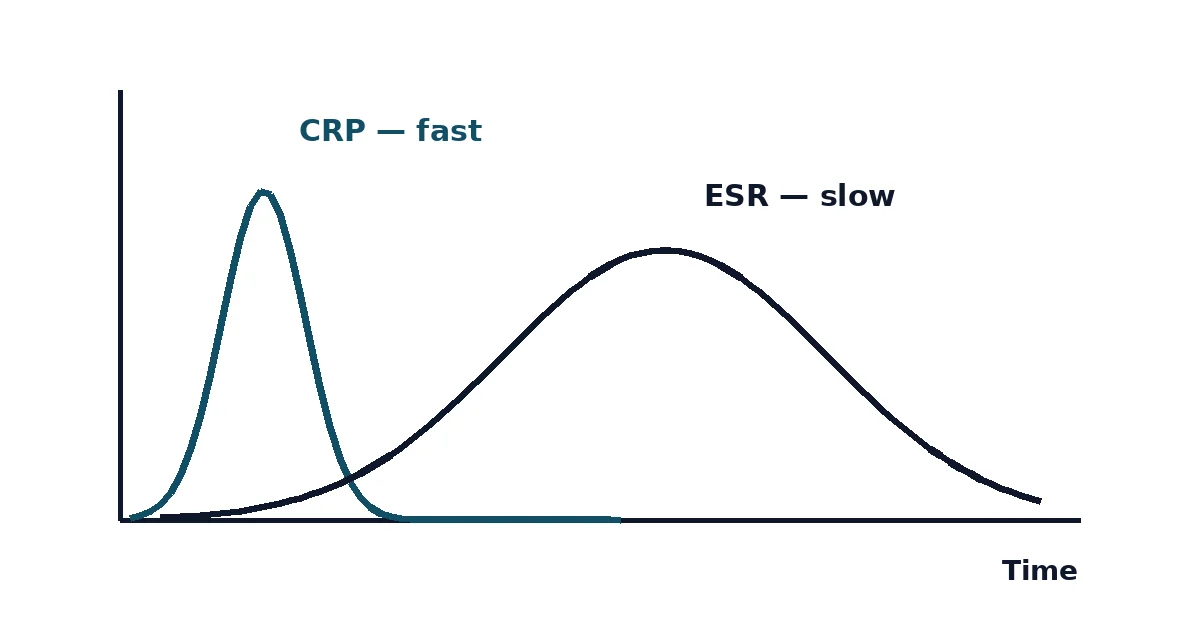
| Response pattern | Generally changes more slowly and can remain raised for longer | Generally changes more rapidly with changes in inflammatory activity |
| Important non-inflammatory influences | Red-cell number and shape, anaemia and other physiological factors can affect the rate | Still non-specific, but usually less affected by red-cell characteristics |
| Can it identify the cause? | No | No |
What does ESR actually measure?
The erythrocyte sedimentation rate is a physical measurement. Anticoagulated blood is placed in a calibrated vertical tube, and the laboratory observes how far the red blood cells settle over the defined test period.
Red blood cells normally tend to remain suspended, but changes in plasma proteins during inflammation can encourage cells to form aggregates that settle more readily. A faster sedimentation rate can therefore be associated with inflammation.
However, the ESR result is affected by more than inflammatory proteins. The number, size and shape of red blood cells can influence settling behaviour, and this is one reason ESR can be altered in situations that do not represent a simple change in inflammatory activity.
For students, the most useful concept is that ESR is an indirect marker. It is not measuring an inflammatory molecule directly.
What does CRP actually measure?
C-reactive protein is an acute-phase protein whose concentration can increase when inflammatory signalling stimulates the liver. A CRP test measures that protein concentration using a laboratory assay rather than observing cell movement.
CRP often responds more rapidly to changes in inflammatory activity than ESR and can also fall more quickly as the stimulus resolves. This makes it useful when clinicians want a marker that reflects relatively recent changes.
But CRP is still non-specific. A raised result can occur with infection, inflammatory disorders, tissue injury and other conditions. The test cannot identify where inflammation is occurring or what caused it.
That distinction matters: CRP may be a more dynamic marker, but it is not a diagnosis.
Why can ESR and CRP give different results?
Discordant results are not unusual because the tests respond to different biological influences. ESR depends partly on the physical behaviour of red blood cells and the plasma environment, whereas CRP measures one specific acute-phase protein.
For example, an altered red-cell count or morphology can influence ESR without causing a matching change in CRP. Conversely, a relatively recent inflammatory change may alter CRP before the slower ESR response becomes prominent.
Timing also matters. If inflammation is resolving, CRP may fall sooner while ESR remains raised for longer. This does not mean one result is automatically correct and the other incorrect.
Clinicians interpret the pattern together with symptoms, medical history, examination findings and other investigations.
Which one responds faster to inflammation?
In general, CRP responds faster to changes in inflammatory activity than ESR. It is produced as part of the acute-phase response and can change over a shorter time frame.
ESR is influenced by downstream changes in plasma proteins and red-cell settling behaviour, so it tends to respond and normalise more slowly. That slower behaviour can sometimes be useful, depending on the clinical question.
Avoid turning this into a rule that CRP is always “better”. Laboratory tests are selected because of what they contribute to a particular clinical pathway, and some conditions have established uses for ESR, CRP or both.
Is one test more specific than the other?
Neither ESR nor CRP is specific for a single disease. Both can indicate that an inflammatory process may be present, but neither tells the clinician exactly where the inflammation is or what caused it.
CRP is a more direct biochemical measurement of an acute-phase protein, whereas ESR can be influenced by a wider range of haematological and physiological factors. That can make CRP easier to relate to short-term inflammatory change in many situations.
However, “more direct” does not mean “disease-specific”. A raised CRP still requires clinical interpretation, just as a raised ESR does.
Why might a doctor order both ESR and CRP?
The two tests can provide complementary information because their response patterns are not identical. If both are requested, the clinician may be interested in the overall inflammatory picture rather than expecting the values to match.
A combination of results can also prompt the clinician to consider whether a non-inflammatory factor is influencing one of the tests. For example, a markedly altered blood count may help explain why an ESR behaves differently from CRP.
This is one reason laboratory medicine rarely interprets a single result in isolation. The value of a test often comes from how it fits with other measurements and the clinical picture.
Does a normal ESR or CRP rule out inflammation?
No. A normal result does not prove that no inflammatory process is present. The sensitivity of either marker depends on the condition, timing, degree of inflammation and individual biology.
MedlinePlus specifically notes that it is possible to have a condition causing inflammation with a normal ESR. The same general caution applies to CRP: a low result is not a universal exclusion test for every inflammatory disease.
For readers, the practical takeaway is to avoid using a single ESR or CRP result as a self-diagnosis tool. These are context-dependent markers, not yes-or-no disease detectors.
Are ESR and CRP collected in the same type of tube?
Not necessarily. ESR requires an anticoagulated whole-blood specimen collected and tested under a standardised method. CRP is a biochemical assay that may be measured in serum or an appropriate plasma specimen depending on the laboratory method.
This makes the pre-analytical requirements different even when both are ordered at the same appointment. The laboratory collection guide determines the correct tube and handling for each assay.
From a biomedical-science perspective, the tests are a good example of why “blood test” is a broad phrase. Two tests aimed at the same clinical concept can use very different analytical principles.
The key difference to remember
– ESR: an indirect measurement based on red-cell settling.
– CRP: a direct measurement of an acute-phase protein.
CRP generally changes faster, while ESR changes more slowly and is more affected by red-cell and other physiological factors. Neither identifies the cause of inflammation by itself.
Related reading
For the sedimentation method itself, see [LINK: esr-blood-test-explained — how the ESR blood test works]. For the acute-phase protein measurement, see [LINK: crp-blood-test-explained — how the CRP blood test works].
FAQ
Is CRP better than ESR for detecting inflammation?
There is no universal rule that one test is always better. CRP generally responds more quickly to changes in inflammatory activity and is less dependent on red-cell characteristics. ESR changes more slowly and can still be useful in particular clinical pathways or alongside other information. The appropriate test depends on the clinical question rather than a simple ranking of the two markers.
Can ESR be high when CRP is normal?
Yes. ESR and CRP are influenced by different biological factors, so the results do not always rise and fall together. ESR can be affected by red-cell characteristics and other physiological factors as well as inflammation. The timing of the inflammatory process can also contribute to a mismatch. A healthcare professional should interpret a discordant pattern using the clinical context and other tests.
Can CRP be high when ESR is normal?
Yes. CRP can respond relatively quickly to a change in inflammatory activity, while ESR may respond more slowly. This means the timing of sample collection can contribute to different patterns. Neither result alone identifies the cause of the inflammation. A raised value needs to be assessed together with symptoms, examination findings and other investigations.
Does a normal CRP mean there is no inflammation?
No. A normal CRP does not automatically rule out every inflammatory condition. The result depends on the type, location, timing and intensity of the biological process, as well as individual variation. Some conditions may not produce a large CRP response. Personal results should therefore be interpreted by a healthcare professional rather than used as a stand-alone exclusion test.
Is ESR a direct measurement of inflammatory proteins?
No. ESR measures how quickly red blood cells settle under standardised conditions, so it is an indirect marker of inflammation. Changes in plasma proteins can alter how red cells interact and settle, which links the test to inflammatory activity. Red-cell number and morphology can also affect the measurement. That is why ESR is different from CRP, which measures a specific protein concentration.
Why are ESR and CRP sometimes repeated over time?
Repeated ESR or CRP measurements can show how an inflammatory marker changes over time rather than providing only one snapshot. CRP often changes more rapidly, while ESR may remain altered for longer. The trend can be useful when interpreted alongside the person’s clinical course and other investigations. A trend still does not identify the underlying cause by itself.
Educational purposes only. Not medical advice.
### FACT-CHECK SOURCES — NOT FOR PUBLICATION
– MedlinePlus, *Erythrocyte Sedimentation Rate (ESR)*.
– MedlinePlus Medical Encyclopedia, *C-reactive protein*.
—
## 4) IBMS vs HCPC