

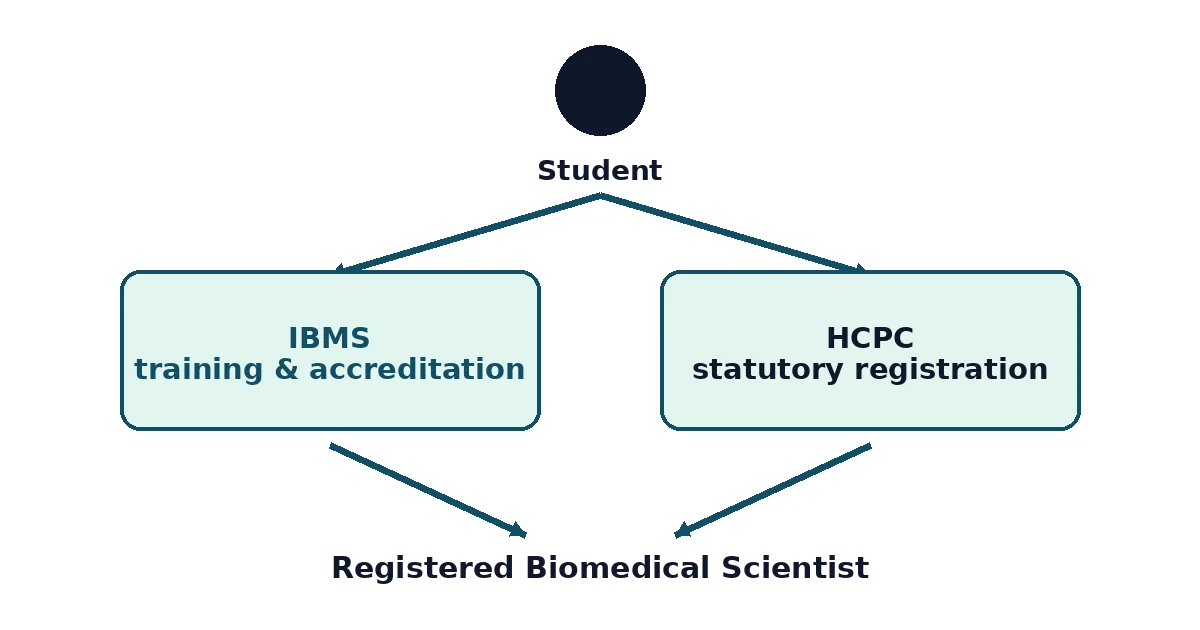
The IBMS and HCPC are different organisations with different jobs. The Institute of Biomedical Science supports professional education, accreditation and development in biomedical science, while the Health and Care Professions Council is the statutory regulator that maintains the professional register and protects the title “biomedical scientist” in the UK.
A useful way to remember the difference is: IBMS helps build and evidence the route to professional competence; HCPC decides whether you meet the requirements to be registered and use the protected title.
IBMS vs HCPC at a glance
| Feature | IBMS | HCPC |
|---|---|---|
| Full name | Institute of Biomedical Science | Health and Care Professions Council |
| Main role | Professional body for biomedical science; accredits relevant degree programmes, supports training and awards professional qualifications | Statutory regulator for multiple health and care professions, including biomedical scientists |
| Key student/graduate function | Accredited-degree pathways, degree assessment, Registration Training Portfolio and Certificate of Competence routes | Registration against regulatory standards and maintenance of the professional register |
| Membership | Offers professional membership grades and member services | Registration is not professional-body membership |
| Protected title | Does not itself grant the legal right to use the protected title | “Biomedical scientist” is a protected title linked to HCPC registration |
| Are they interchangeable? | No. IBMS membership/accreditation and HCPC registration are separate concepts | |
What does the IBMS do?
The Institute of Biomedical Science is the professional body most closely associated with biomedical science practice and education in the UK. Its role includes accrediting biomedical science degree programmes, supporting professional development, publishing professional resources and providing qualifications and training routes linked to registration.
For a student who wants the most direct conventional route towards becoming an HCPC-registered biomedical scientist, an IBMS Accredited biomedical science degree is particularly important. Current IBMS guidance states that an accredited degree provides the academic knowledge required for the route, while practical competence is demonstrated through an approved training pathway such as the IBMS Registration Training Portfolio.
The IBMS also assesses certain non-accredited qualifications for people seeking to identify gaps in the academic requirements for the UK route. Depending on the outcome, supplementary education may be required before the person can complete the relevant training and registration steps.
What does the HCPC do?
The Health and Care Professions Council is a statutory regulator. It regulates several health and care professions and sets standards that applicants and registered professionals must meet.
For biomedical science, the crucial point is that “biomedical scientist” is a protected title. A person must be appropriately registered with the HCPC to use that title lawfully in the UK.
HCPC registration is therefore not an optional professional-club membership. It is the regulatory status associated with practising under the protected professional title.
The HCPC publishes standards of proficiency for biomedical scientists, as well as broader standards relating to conduct, performance, ethics and continuing professional development.
Is IBMS membership the same as HCPC registration?
No. This is one of the most common sources of confusion for students.
You can be connected with the IBMS through study, membership, qualifications or professional development, but IBMS membership is not the same thing as HCPC registration. Likewise, appearing on the HCPC Register is not the same as being an IBMS member.
They serve different purposes. IBMS is a professional body and education/training organisation within biomedical science; HCPC is the regulator.
When a job advert says that the applicant must be an HCPC-registered biomedical scientist, professional-body membership does not replace that requirement.
Why does IBMS accreditation matter if HCPC is the regulator?
Because registration requires evidence that the applicant has met the required standards, and the UK training pathway needs a way to connect academic education with practical laboratory competence.
IBMS Accredited biomedical science degrees are designed to cover the academic content needed for the professional route. The IBMS Registration Training Portfolio then provides a structured way for candidates in approved laboratories to demonstrate practical competence against the relevant HCPC standards.
On successful completion of the appropriate academic and training requirements, the IBMS can award the Certificate of Competence, enabling the candidate to apply to the HCPC for registration through that route.
The important distinction is that the IBMS qualification supports eligibility to apply; the HCPC is the organisation that registers the professional.
Do all biomedical science degrees lead directly to HCPC registration?
No. The words “biomedical science” in a degree title do not automatically mean the course is an IBMS Accredited programme or an HCPC-approved route.
Current IBMS guidance states that graduates with a non-IBMS Accredited BSc who want to use the relevant UK route may need an IBMS degree assessment to identify academic gaps and any supplementary education. An accredited postgraduate degree does not automatically erase gaps in an unaccredited undergraduate degree, according to the IBMS’s current route guidance.
This is a major practical point for prospective students: if the career goal is to become a registered biomedical scientist, check the programme’s current accreditation and placement structure before enrolling, not after graduation.
What is the Registration Training Portfolio?
The IBMS Registration Training Portfolio is the practical competence component used in the established IBMS route to HCPC registration. Candidates complete it in an IBMS-approved training laboratory with appropriate supervision and evidence of competence.
The current Version 5 portfolio is mapped to HCPC Standards of Proficiency for biomedical scientists. The portfolio is not simply a collection of university assignments; it demonstrates how the candidate meets professional standards in real laboratory practice.
Successful completion and verification contribute to the award of the IBMS Certificate of Competence. The candidate can then apply to HCPC for registration through the relevant route.
Do you need to join the IBMS to be HCPC registered?
Do not treat “IBMS membership” and the “IBMS registration route” as the same thing. The route can involve an IBMS-accredited degree, IBMS portfolio and IBMS qualification, while professional membership status is a separate concept.
The exact requirements that apply to a candidate depend on the registration route and their qualifications. International applicants, for example, may have a different HCPC application pathway from a UK graduate following the standard accredited-degree-and-portfolio route.
For a specific case, the safest source is the current IBMS and HCPC guidance, because eligibility and application routes can change.
What if your degree is not IBMS Accredited?
A non-accredited degree does not automatically mean that a biomedical science career is impossible. It means the graduate should not assume that the degree has already satisfied the academic component of the standard UK registration route.
The IBMS currently provides a degree-assessment process for relevant graduates. The assessment can identify areas where supplementary education is required before the candidate proceeds through the relevant competence pathway.
International graduates may also have access to the HCPC’s international application route, depending on their education and professional background. If an international application is unsuccessful or gaps are identified, further academic or practical steps may be needed.
Because these are regulatory decisions, applicants should use the official organisations’ current advice rather than relying on an old forum post or a university marketing page.
Which organisation should students check first?
If you are choosing a UK biomedical science degree with the goal of becoming a registered biomedical scientist, start by checking whether the specific degree programme is currently IBMS Accredited and whether it includes an approved clinical placement and portfolio opportunity.
If you are approaching registration, changing route, trained overseas or have unusual qualifications, check both organisations. IBMS information can clarify education and training pathways, while HCPC information covers registration and regulatory standards.
The simplest summary is:
– IBMS: professional body, accreditation, education, portfolio and competence qualifications.
– HCPC: statutory regulator and professional register.
You may interact with both, but they are not substitutes for each other.
Related reading
For the professional-body side, see [LINK: ibms-membership-explained — what IBMS membership means]. For the statutory registration process, see [LINK: hcpc-registration-biomedical-scientist — how HCPC registration works for biomedical scientists].
FAQ
Is IBMS the same as HCPC?
No. The IBMS is a professional body for biomedical science, while the HCPC is a statutory regulator for several health and care professions. IBMS work includes accreditation, education, professional development and competence qualifications. HCPC registration is the regulatory status linked to the protected title “biomedical scientist” in the UK.
Does IBMS membership make you a registered biomedical scientist?
No. IBMS membership does not automatically make someone HCPC registered. Registration requires the applicant to meet the HCPC’s requirements through an appropriate route and be accepted onto the HCPC Register. An IBMS Accredited degree, Registration Training Portfolio and Certificate of Competence can form part of a common UK route. The final professional registration is with HCPC, not the IBMS membership system.
Do I need an IBMS Accredited degree to become a biomedical scientist?
An IBMS Accredited degree is the most direct conventional UK academic route described by the IBMS, but it is not the only possible situation an applicant may have. Graduates from non-accredited courses may need an IBMS degree assessment and supplementary education, while some applicants may use other approved or international routes. The requirements depend on the person’s qualifications and training history. Always check the current official route guidance before making education or career decisions.
What does the IBMS Certificate of Competence do?
The IBMS Certificate of Competence confirms successful completion of the relevant academic and practical competence requirements in the IBMS route. It is associated with completion and verification of the Registration Training Portfolio in an approved training environment. The certificate supports eligibility to apply for HCPC registration through that pathway. It does not mean the person should skip the HCPC application itself.
Is “biomedical scientist” a protected title in the UK?
Yes. Biomedical scientist is a protected professional title regulated by the HCPC in the UK. That means the title is tied to statutory professional registration rather than simply holding a degree with “biomedical science” in its name. Other laboratory job titles may have different regulatory status. Anyone unsure which title they can lawfully use should check the HCPC’s current protected-title guidance.
Should I check IBMS or HCPC if I studied outside the UK?
You may need to check both organisations, depending on your circumstances. HCPC provides an international application route for eligible overseas-trained professionals, while IBMS guidance covers degree assessment and education/training routes that may become relevant in some cases. Overseas qualifications are not automatically treated as identical to a UK accredited pathway. Use current HCPC and IBMS guidance for an individual eligibility decision rather than assuming equivalence from the degree title.
Educational purposes only. Not medical advice.
### FACT-CHECK SOURCES — NOT FOR PUBLICATION
– Institute of Biomedical Science, *Become a biomedical scientist*.
– Institute of Biomedical Science, *IBMS Accredited BSc degree with registration portfolio*.
– Institute of Biomedical Science, *Non IBMS Accredited BSc degree*.
– Institute of Biomedical Science, *Certificate of Competence*.
– Health and Care Professions Council, *Standards of proficiency — biomedical scientists*.
—
## 5) Biomedical Scientist vs Lab Technician