
⚕️ Educational content only. This article explains electrolyte tests from a biochemistry and laboratory medicine perspective. It is not medical advice. Consult a healthcare professional for personal health concerns.
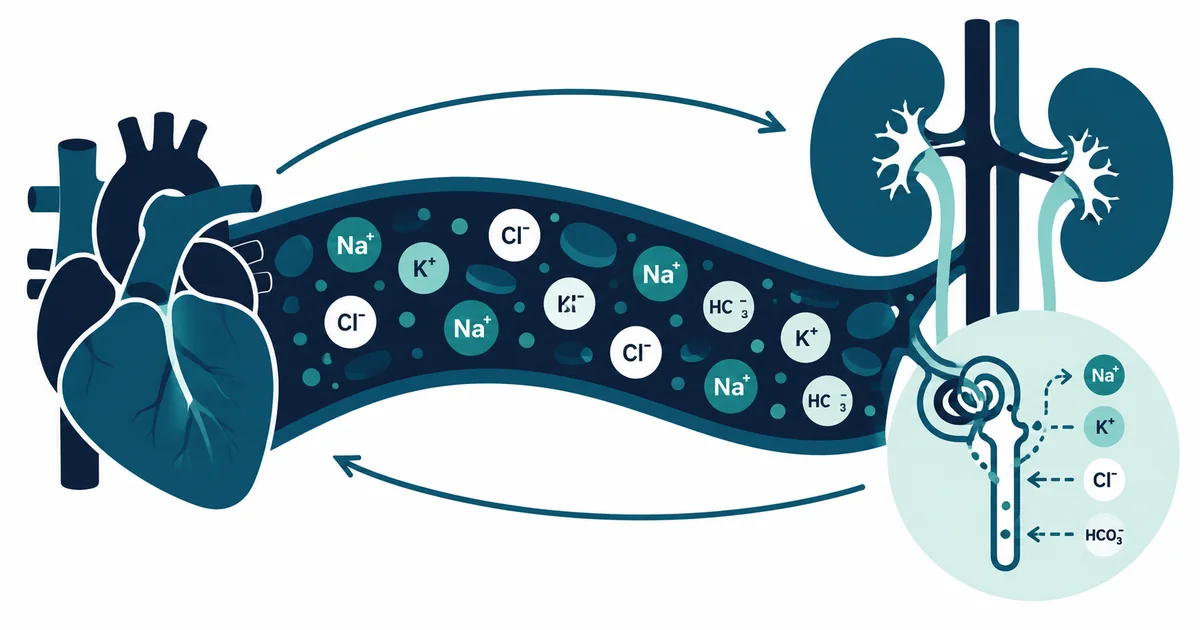
Electrolytes are electrically charged minerals that regulate fluid balance, nerve conduction, and acid-base homeostasis. The four main serum electrolytes — sodium, potassium, chloride, and bicarbonate — are measured as part of a standard urea and electrolytes (U&E) panel and are among the most frequently ordered laboratory tests in clinical medicine.
Key Takeaways
- Sodium is the primary extracellular cation and the main determinant of plasma osmolality; dysnatraemia reflects disorders of water balance.
- Potassium is the primary intracellular cation; hypokalaemia and hyperkalaemia can cause life-threatening cardiac arrhythmias.
- Bicarbonate is the principal blood buffer and reflects acid-base status; it must be interpreted alongside pH, pCO2, and anion gap.
- Electrolyte results are always interpreted together as a panel, not in isolation.
Sodium (Na+)
Reference range: 135–145 mmol/L. Sodium is the dominant extracellular cation and controls plasma osmolality and water distribution. Hyponatraemia (<135 mmol/L) is the commonest electrolyte abnormality in hospitalised patients. Causes include SIADH (syndrome of inappropriate ADH secretion), heart failure, liver cirrhosis, hypothyroidism, and excessive water intake. Hypernatraemia (>145 mmol/L) reflects a relative water deficit — caused by dehydration, diabetes insipidus, or excessive sodium intake. Symptoms of both depend on the rate of change as much as the magnitude; acute shifts are more dangerous than chronic ones.
Potassium (K+)
Reference range: 3.5–5.0 mmol/L. Potassium is predominantly intracellular (98% intracellular vs. 2% extracellular). Hypokalaemia (<3.5 mmol/L) causes muscle weakness, cramps, ileus, and cardiac arrhythmias (U waves on ECG). Causes include diuretic use, vomiting, diarrhoea, alkalosis, and hypomagnesaemia. Hyperkalaemia (>5.0 mmol/L) can cause peaked T waves, widened QRS, and ventricular fibrillation. Causes include renal failure, ACE inhibitor/potassium-sparing diuretic use, Addison’s disease, acidosis, and haemolysis (which releases intracellular K+, causing spuriously high results).
Chloride (Cl-)
Reference range: 98–106 mmol/L. Chloride is the principal extracellular anion and generally follows sodium. Hyperchloraemia occurs in hypernatraemia, normal saline infusion (dilutional), and metabolic acidosis with normal anion gap (e.g. diarrhoea, renal tubular acidosis). Hypochloraemia occurs in vomiting (loss of HCl), diuretic use, and metabolic alkalosis. Chloride is essential for calculating the anion gap: Anion Gap = Na+ − (Cl− + HCO3−); normal is 8–12 mmol/L (or up to 16 mmol/L if albumin not corrected).
Bicarbonate (HCO3-)
Reference range: 22–29 mmol/L. Bicarbonate is the principal blood buffer and the metabolic component of acid-base balance. Low HCO3− indicates metabolic acidosis (DKA, lactic acidosis, renal failure, diarrhoea). High HCO3− indicates metabolic alkalosis (vomiting, diuretic use, hypokalaemia). HCO3− on a standard biochemistry panel is measured as total CO2 and is slightly higher than true HCO3−. Full acid-base interpretation requires arterial blood gas (ABG) analysis, providing pH, pCO2, and HCO3− together.
Interpreting the U&E Panel Together
Electrolytes are always interpreted as a panel. A low sodium with low potassium in a patient on diuretics tells a different story to the same values in someone with renal failure. The anion gap, osmolar gap, and acid-base status all add context. Urea and creatinine from the same panel assess renal function — see Kidney Function Test Explained for more detail. Clinical assessment of fluid status — hydration, blood pressure, oedema — is essential to interpret electrolyte abnormalities correctly. As with all biochemistry panels, results should be interpreted by a qualified healthcare professional in the context of symptoms, history, medicines, and other findings.
References
- MedlinePlus. Electrolytes. medlineplus.gov
- NHS. Blood tests: urea and electrolytes. nhs.uk
- Kasper DL, et al. Harrison’s Principles of Internal Medicine. 20th ed. McGraw-Hill; 2018. Ch. 49: Fluid and Electrolyte Disturbances.
More questions answered
What can the electrolyte blood test tell you, and what can it not tell you?
The electrolyte blood test provides information about the concentrations of electrically charged substances such as sodium and potassium. It can support assessment of fluid and electrolyte balance, but it usually cannot identify the exact cause of an abnormal value by itself. The result becomes more useful when combined with kidney function, glucose and acid-base measurements and the reason the test was requested. The main limitation is that one laboratory measurement is only part of the wider clinical picture.
Why are other blood tests often ordered with the electrolyte blood test?
Related tests can show whether a change in the electrolyte blood test fits a broader laboratory pattern. Measurements such as kidney function, glucose and acid-base measurements may assess connected organs, pathways or biological processes. This can help clinicians distinguish between several possible explanations for the same result. The tests are therefore complementary rather than interchangeable.
Can medicines or supplements affect the electrolyte blood test?
Yes, some medicines or supplements can influence the electrolyte blood test directly or indirectly, although the effect depends on the specific substance and assay. Other influences include hydration, kidney function, hormones, medicines and sample quality, so medication is only one possible explanation for a change. Patients should not stop prescribed treatment just to alter a laboratory result unless a healthcare professional has specifically instructed them to do so. Medication information should be shared with the healthcare team interpreting the result.
Why might a healthcare professional request another electrolyte blood test?
A second electrolyte blood test may be used to confirm an unexpected result, check a trend or see whether a temporary change has resolved. Repeating the test can also help when the first specimen had a quality problem or when monitoring requires measurements at different times. A repeat value is interpreted alongside the earlier result rather than treated as an unrelated number. The need for retesting depends on the clinical question.
Why might my electrolyte blood test result be flagged at one laboratory but not another?
Laboratories can use different reference intervals or decision limits because methods, instruments, reagents and populations differ. A value near a boundary may therefore be flagged differently even when the numerical results are similar. This does not automatically mean that one laboratory made an error. Always use the range printed on the same report as the result being interpreted.
Can my electrolyte blood test result change even when I feel the same?
Yes. Laboratory values can change because of normal biological variation, early physiological changes, medicines, hydration, timing or other factors before noticeable symptoms occur. Feeling well also does not guarantee that every laboratory measurement will sit inside its reference interval. The importance of a change depends on its size, persistence and clinical context. Personal results should be discussed with a healthcare professional when interpretation is needed.
Does a normal electrolyte blood test rule out every related condition?
No. A result inside the reference interval does not exclude every condition related to the biological system being tested. Some disorders may not affect the marker, may affect it only at certain stages or may require other tests to detect. Clinicians therefore consider symptoms, examination and related investigations rather than using one normal value as a universal rule-out. The electrolyte blood test should be interpreted according to the purpose for which it was ordered.
Anion Gap Blood Test: High and Low Results
Osmolality vs Osmolarity: What’s the Difference?