

Serum and plasma are both liquid parts of blood used for laboratory testing, but they are not the same specimen. The key difference is what happens before centrifugation: plasma comes from blood that has been prevented from clotting, while serum is collected after the blood has been allowed to clot.
That distinction changes which proteins remain in the sample, which collection tube is used and which tests the laboratory can perform.
Serum vs plasma at a glance
| Feature | Serum | Plasma |
|---|---|---|
| How it is produced | Blood is allowed to clot, then centrifuged | Blood is collected with an anticoagulant, then centrifuged |
| Clotting components | Clotting has already occurred, so fibrinogen and some clotting components are consumed or removed with the clot | Retains fibrinogen and other soluble clotting components |
| Typical collection approach | Plain or clot-activator serum tube, depending on the test and local laboratory procedure | Tube containing an anticoagulant such as citrate, heparin or EDTA, selected for the requested test |
| Common uses | Many chemistry, immunology and serology assays | Coagulation testing and many chemistry or molecular assays, depending on the validated method |
| Pre-centrifugation step | Requires clot formation before serum can be separated | Does not require the sample to clot |
| Can they always be substituted? | No. The analyser method and laboratory procedure specify which specimen types are acceptable | |
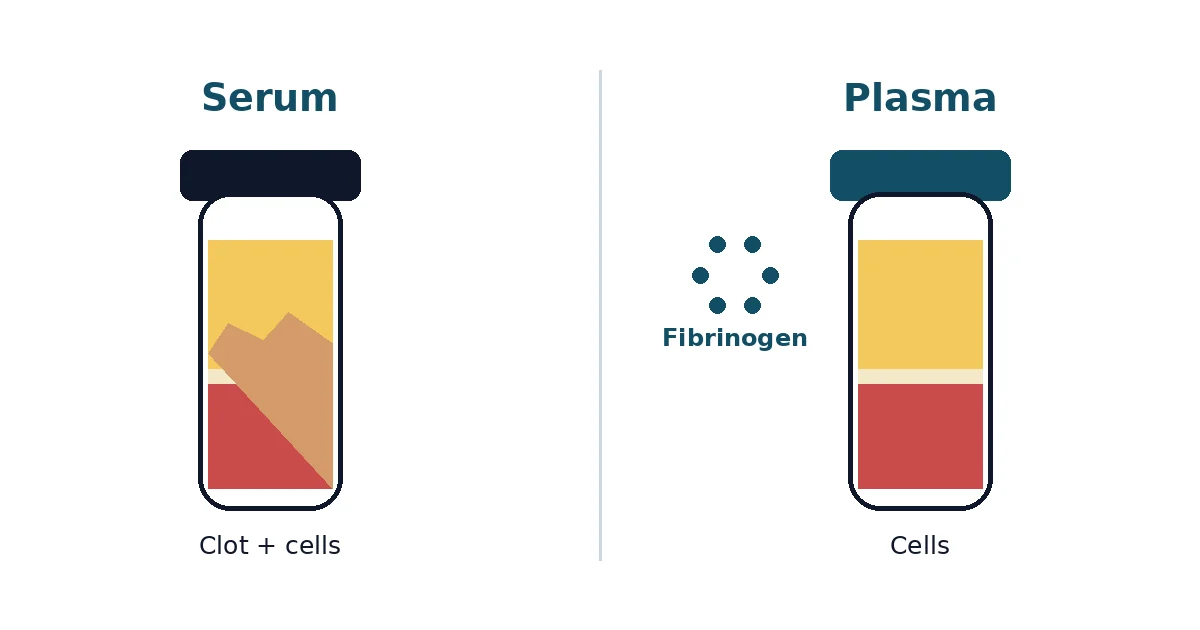
What exactly is plasma?
Plasma is the liquid portion obtained when blood is collected in a tube that prevents coagulation and the blood cells are then separated, usually by centrifugation. Because the sample has not been allowed to form a clot, soluble clotting components such as fibrinogen remain in the plasma.
The anticoagulant is not an interchangeable ingredient. Different laboratory tests require different collection systems because additives can affect the reaction being measured. Citrate plasma, for example, is used for many coagulation studies because the collection and test system is designed around a controlled relationship between the blood and citrate. Other plasma-based assays may use heparin or EDTA according to the method validated by the laboratory.
This is why the phrase “a plasma sample” is not enough to choose a tube. The specific test request determines the acceptable plasma type.
What exactly is serum?
Serum is the liquid remaining after blood has been allowed to clot and the clot and cells have been separated. During clot formation, fibrinogen is converted as part of the coagulation process and becomes associated with the clot, so serum does not contain the same functional clotting system as anticoagulated plasma.
Serum is widely used for laboratory investigations because many biochemical, immunological and serological methods have been validated for it. A serum tube may contain a clot activator and, in some collection systems, a gel that helps form a barrier between the serum and cells after centrifugation.
The important point is that serum is not simply “better” or “cleaner” plasma. It is a different analytical matrix created by a different pre-analytical process.
Why does the difference matter in the laboratory?
The specimen matrix can affect the validity of a result. Laboratory analysers, reagents and reference intervals are developed and verified for specified sample types. If an assay is validated for serum, substituting a different plasma type without evidence that the method accepts it can introduce analytical problems.
The clearest example is coagulation testing. Tests that assess the coagulation system require an appropriate plasma specimen because the laboratory needs the relevant clotting components to remain available for the test reaction. Serum has already undergone clot formation, so it is unsuitable for that purpose.
For routine chemistry, the distinction is more method-dependent. Some assays accept both serum and certain types of plasma, while others specify one matrix. Laboratories therefore follow the analyser manufacturer’s instructions together with their own validated procedures rather than assuming that serum and plasma are interchangeable.
Does plasma give faster results than serum?
Plasma can sometimes reduce one pre-analytical delay because the laboratory does not need to wait for clot formation before centrifugation. Serum preparation includes a clotting step, so there is normally a period between collection and centrifugation to allow an adequate clot to form.
That does not mean every plasma test has a faster turnaround time. Overall turnaround depends on transport, centrifugation, analyser workflow, batching, urgency, repeat testing and result validation. The specimen type is only one part of the process.
For students, the useful principle is simple: plasma avoids a clotting wait, but the laboratory chooses the specimen based on analytical suitability, not speed alone.
Can serum and plasma results be different?
Yes. The clotting process changes the sample, and the collection additives used for plasma can also influence what is measured. Research comparing paired serum and plasma specimens has shown that concentrations of some proteins, metabolites and other analytes can differ between the two matrices.
This matters particularly when a laboratory establishes a method and its reference interval. A result from one specimen type should not automatically be assumed to be directly equivalent to a result from another specimen type unless the method supports that comparison.
It is another reason to use the specimen named on the test request and laboratory instructions rather than treating “blood” as a single universal sample.
Which tube should be used for serum or plasma?
There is no single colour rule that can safely be applied across every collection system worldwide. Tube-cap colours can vary by manufacturer and local policy, and similar-looking tubes can contain different additives.
For serum, laboratories use collection tubes designed to allow clot formation, sometimes with a clot activator and separator gel. Plasma requires a tube containing the anticoagulant specified for the test, such as citrate, heparin or EDTA.
The practical rule is to follow the local laboratory collection guide and the test-specific instructions. Never choose a tube only from a colour remembered from another hospital, country or manufacturer.
The key difference to remember
If you only remember one concept, use this:
– Plasma: blood is prevented from clotting before the liquid is separated.
– Serum: blood is allowed to clot before the liquid is separated.
That one pre-analytical difference explains why plasma retains fibrinogen and why serum and plasma cannot always be used for the same tests.
Related reading
For the collection step itself, see [LINK: blood-sample-collection-explained — how blood samples are collected]. For the next stage, see [LINK: what-happens-to-your-blood-sample-in-the-lab — what happens to your blood sample in the laboratory].
FAQ
Is serum the same as plasma without blood cells?
Not exactly. Both serum and plasma are separated from blood cells, but serum is produced after clotting whereas plasma is produced from anticoagulated blood. During clotting, fibrinogen and other components of the coagulation process are changed or removed with the clot. The practical difference is therefore about the clotting process, not simply whether blood cells are present.
Does plasma contain clotting factors?
Plasma retains fibrinogen and other soluble components involved in coagulation because the sample has been prevented from clotting before separation. That is why appropriately collected citrate plasma is used for many coagulation tests. The exact anticoagulant and collection conditions matter because the test system is designed for a particular specimen. Laboratories therefore follow a validated collection procedure rather than using any plasma tube.
Why can’t serum be used for routine coagulation tests?
Serum is obtained after the blood has already formed a clot, so the sample no longer represents the intact coagulation system required for routine clotting assays. Tests such as those assessing clot formation are designed to use an appropriate plasma specimen in which relevant soluble clotting components have been preserved. Using the wrong matrix could make the test invalid rather than simply shifting the result slightly. The laboratory collection guide should therefore be followed for every coagulation request.
Are serum and plasma interchangeable for chemistry tests?
Sometimes an assay can accept both, but they should not automatically be treated as interchangeable. The acceptable specimen depends on the analyser, reagent system and validation performed by the laboratory. An anticoagulant can interfere with some measurements, while clotting can alter concentrations of certain analytes in serum. The test directory or laboratory instructions should specify whether serum, plasma or both are acceptable.
Which is collected first, serum or plasma?
The order in which blood tubes are collected is governed by the laboratory’s order-of-draw procedure, not by a simple rule that serum always comes before plasma. The purpose is to reduce the risk that additives from one tube contaminate another specimen. Collection systems and local procedures must be followed carefully, particularly for tests affected by anticoagulants. Staff should use the approved phlebotomy guidance for their service rather than relying on memory from a different setting.
Can the same blood draw produce both serum and plasma?
A patient can have tubes collected during the same venepuncture for tests requiring different specimen types, but serum and plasma are normally prepared from different appropriately selected tubes. One tube allows clotting, while another contains the required anticoagulant. The laboratory cannot simply turn already clotted serum back into plasma. The requested tests determine which collection tubes are needed at the time of sampling.
Educational purposes only. Not medical advice.
### FACT-CHECK SOURCES — NOT FOR PUBLICATION
– World Health Organization, *Serum, Plasma or Whole Blood? Which Anticoagulants to Use?* — WHO/DIL/LAB/99.1 Rev.2.
– Liu X, Hoene M, Wang X, et al. *Serum or plasma, what is the difference?* Analytica Chimica Acta. 2018;1037:293–300. PubMed PMID 30292305.
—
## 2) HbA1c vs Fasting Glucose