

A biomedical scientist and a lab technician may work in the same laboratory, handle similar equipment and contribute to the same testing service, but the job titles are not interchangeable. In the UK, “biomedical scientist” is a protected professional title linked to HCPC registration, while “lab technician” is a broader job title whose duties and entry requirements vary by employer and sector.
The practical difference is therefore not just “one has a degree and one does not”. It is about regulatory status, scope of practice, training pathway and responsibility within the laboratory.
Biomedical scientist vs lab technician at a glance
| Feature | Biomedical Scientist | Lab Technician |
|---|---|---|
| UK regulatory status | “Biomedical scientist” is a protected HCPC-regulated title | “Lab technician” is generally an employer-defined job title rather than the HCPC-protected biomedical scientist title |
| Typical setting | Diagnostic pathology, NHS/private healthcare laboratories, specialist services | Healthcare, research, education, industry, manufacturing and other laboratory settings |
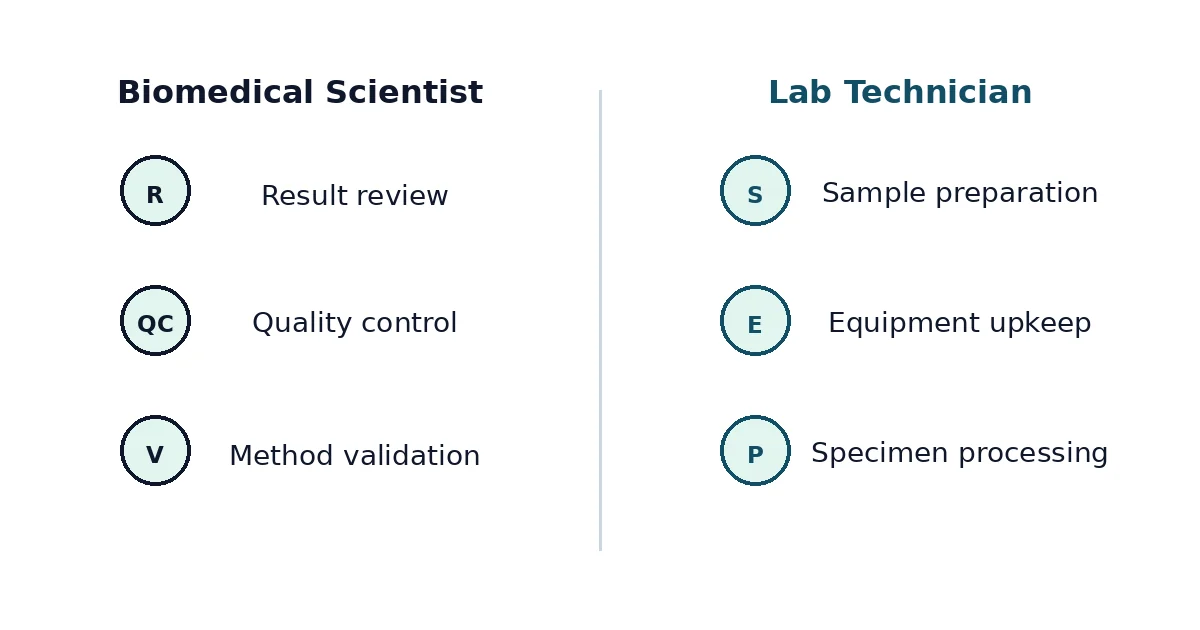
| Typical work | Analytical testing, quality control, troubleshooting, result validation/authorisation within scope and specialist laboratory responsibilities | Sample preparation, routine technical procedures, equipment support, stock, records and other duties defined by the employer |
| Training route | Requires an appropriate route to HCPC registration | Entry requirements vary widely by employer, sector and level of role |
| Professional registration | HCPC registration is required to use the protected title in the UK | No single UK professional registration applies to every job called “lab technician” |
| Can one role lead to the other? | Potentially, but progression requires meeting the education, competence and registration requirements for biomedical scientist practice | |
What does a biomedical scientist do?
Biomedical scientists analyse patient specimens to produce laboratory information used by clinical teams. Depending on the discipline, this can involve blood counts, clinical chemistry, microbiology, transfusion science, histopathology, immunology, molecular testing and other specialist areas.
The role includes much more than pressing “start” on an analyser. Biomedical scientists may assess sample suitability, perform internal quality control, investigate analyser flags, troubleshoot technical problems, validate or authorise results within their scope and communicate significant findings according to laboratory procedures.
They also work within formal quality systems. That includes standard operating procedures, traceability, equipment maintenance, incident reporting, external quality assessment and continuing professional development.
In the UK, the key legal point is that biomedical scientist is an HCPC-protected title. A person must follow an appropriate registration route and be on the HCPC Register to use that title lawfully.
What does a lab technician do?
“Lab technician” is a much broader label. A technician may work in a hospital laboratory, university, school, pharmaceutical company, biotechnology firm, food laboratory, environmental laboratory or industrial setting.
Typical duties can include preparing samples and reagents, pipetting, setting up equipment, maintaining stocks, cleaning and decontaminating work areas, recording data and carrying out routine procedures under the laboratory’s quality and safety systems.
In a healthcare laboratory, support roles may be advertised under several titles, including medical laboratory assistant, laboratory support worker, biomedical assistant, associate practitioner or technician, depending on the employer and level of responsibility. The exact boundaries between these roles are not identical across organisations.
That is why a job advert matters more than the word “technician” alone. Two roles with similar titles can have quite different qualification requirements and scopes of practice.
Is a biomedical scientist simply a senior lab technician?
No. That description is too simplistic and can be misleading.
A biomedical scientist belongs to a regulated profession with defined standards of proficiency and a formal registration requirement. A technician role is usually defined by the employer and may exist inside or outside healthcare.
There can certainly be overlap in practical laboratory skills. Both roles may use analysers, pipettes, centrifuges, laboratory information systems and quality procedures. However, the biomedical scientist role carries a specific professional framework and may include responsibilities that require HCPC-registered staff under local laboratory governance.
The difference is therefore about professional scope and accountability, not whether one person “works harder” or “does more science”.
Do biomedical scientists need a degree?
The standard UK biomedical scientist route is degree-based. IBMS guidance describes pathways involving an IBMS Accredited biomedical science degree or another appropriate academic route, together with practical competence training and HCPC registration.
Not every degree with “biomedical science” in the title automatically completes the registration pathway. A student who wants to become a biomedical scientist should check the degree’s current accreditation and whether an approved training placement and Registration Training Portfolio are included.
People with non-accredited or overseas qualifications may have different assessment routes. The important point is that graduation alone does not automatically confer the protected title.
Do lab technicians need a degree?
There is no single answer because “lab technician” covers many sectors and levels. Some employers accept school-leaver qualifications, vocational training or apprenticeships, while other technician posts ask for a science degree or substantial technical experience.
The role can therefore be accessible through several routes. A university research technician working with molecular methods may have a very different background from a school science technician or a laboratory support worker in pathology.
For job seekers, the best approach is to read the person specification carefully. Do not assume that every technician role is entry-level, and do not assume that a science degree automatically meets every specialist technical requirement.
Can a lab technician become a biomedical scientist?
Yes, a technician or laboratory support worker can potentially progress towards biomedical scientist registration, but employment experience alone does not automatically grant the title.
The person still has to meet the required academic and practical competence standards and successfully obtain HCPC registration through an appropriate route. In some healthcare laboratories, support roles can provide useful experience and may create access to training opportunities, apprenticeships or approved portfolio work.
This can be a strong pathway because the person is already familiar with laboratory workflow, quality systems and patient-sample handling. However, the exact progression route depends on qualifications, employer support and availability of approved training.
Anyone planning this move should map their current qualifications against IBMS and HCPC requirements before assuming a particular job will lead directly to registration.
Who can authorise laboratory results?
Result authorisation is governed by the laboratory’s competence framework, quality system and scope-of-practice rules. In many diagnostic services, appropriately trained biomedical scientists have responsibility for validating or authorising defined categories of results, but the exact permissions are set locally and depend on competence.
It would be inaccurate to say that every biomedical scientist can authorise every result or that no technician can ever perform any result-review function. Laboratories use role-specific and competency-based authorisation.
The broader distinction is that biomedical scientists practise within a regulated professional framework, whereas a technician’s duties are determined by the employer and the competence assigned to that post.
Which role has better career progression?
Both can develop into rewarding careers, but the pathways are different.
A biomedical scientist may progress into specialist, senior, quality, training, management or advanced-practice roles after gaining experience and additional professional qualifications. Technicians can also progress into senior technical positions, laboratory management, quality roles, specialist methods, research support or other scientific careers.
For some technicians, progression includes gaining the academic and training requirements needed to become a registered biomedical scientist. For others, the preferred route is deeper technical specialisation without changing professional title.
The better career depends on the person’s goals: regulated diagnostic practice, specialist technical work, research, industry, leadership or another part of laboratory science.
Which role is right for you?
If your goal is to work as a registered biomedical scientist in UK diagnostic healthcare, plan your education around the HCPC registration route from the beginning. Accreditation and access to approved training matter more than the degree title alone.
If you want broad laboratory experience or prefer technical work in research, industry, education or healthcare support, a technician role may be a good fit and may have more flexible entry routes.
Neither title should be treated as universally “better”. They describe different professional structures, and excellent laboratories depend on teams with multiple levels of expertise.
Related reading
For the broader laboratory profession, see [LINK: what-is-a-medical-laboratory-scientist — what a medical laboratory scientist does]. For alternative routes and sectors, see [LINK: biomedical-science-careers — biomedical science career options].
FAQ
Is a biomedical scientist the same as a lab technician?
No. In the UK, biomedical scientist is an HCPC-regulated protected title, while lab technician is a broader employer-defined role. The jobs can share practical laboratory tasks, but their training pathways and professional responsibilities are not identical. Always compare the actual job description rather than assuming the titles are interchangeable.
Can a lab technician work in a hospital laboratory?
Yes. Hospital laboratories employ several support and technical roles alongside registered biomedical scientists and other professionals. Titles can include medical laboratory assistant, support worker, technician or associate practitioner depending on the employer. The duties and competence requirements vary between laboratories. A hospital technician role does not automatically make the person an HCPC-registered biomedical scientist.
Does a lab technician need HCPC registration?
There is no single HCPC registration requirement for every job called lab technician. HCPC regulation applies to specific protected professional titles, including biomedical scientist. A technician post may still have employer-specific qualification, training and competency requirements. Applicants should check the person specification and not assume that a generic job title determines regulatory status.
Can a technician become a biomedical scientist without going back to university?
It depends on the person’s existing academic qualifications and the registration pathway available to them. Experience as a technician can be valuable, but experience alone does not automatically replace the academic and competence requirements for HCPC registration. Some people may be able to use apprenticeship or employer-supported routes, while others may need additional study. The correct route should be checked against current IBMS and HCPC guidance.
Do biomedical scientists have more responsibility than lab technicians?
Biomedical scientists work within a regulated scope of practice and may have responsibilities for analytical interpretation, quality control, troubleshooting and result authorisation according to competence. Technician responsibilities vary widely and can also be highly skilled, particularly in specialist research or industry laboratories. It is therefore better to compare scope, competence and accountability than to rank the roles by a single hierarchy. The exact division of work depends on the laboratory and sector.
Is a biomedical science degree enough to work as a biomedical scientist?
Not necessarily. A biomedical science degree does not automatically confer the protected UK title. The standard route involves meeting the relevant academic requirements, completing approved practical competence training and obtaining HCPC registration. Students should check course accreditation and placement structure before assuming their degree leads directly to registration.
Educational purposes only. Not medical advice.
### FACT-CHECK SOURCES — NOT FOR PUBLICATION
– Health and Care Professions Council, *Standards of proficiency — biomedical scientists*.
– Institute of Biomedical Science, *Become a biomedical scientist*.
– Prospects, *Biomedical scientist* (updated February 2026).
– Prospects, *How to become a lab technician* (updated March 2026).
—
## 6) Ferritin vs Serum Iron