
🎓 Educational content only. This article is for general educational purposes. Job titles, registration requirements, scope of practice, and training pathways vary significantly by country and institution. Always verify current requirements with the relevant professional body in your region.
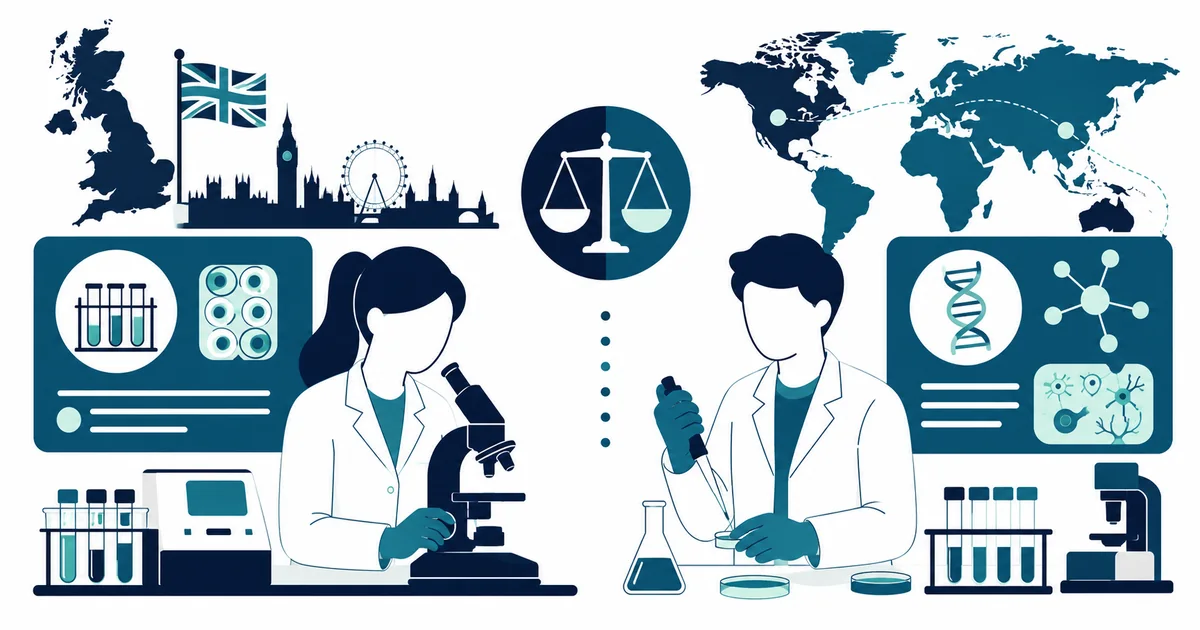
If you have ever searched for careers in laboratory medicine, you have probably encountered both the title medical laboratory scientist (MLS) and biomedical scientist (BMS) — and wondered whether they refer to the same job. The short answer is: mostly yes, but the terminology depends on where in the world you are. The same core profession — performing diagnostic laboratory tests on patient samples — goes by different names in different countries, with different educational pathways, registration requirements, and professional bodies.
Key Takeaways
- “Medical laboratory scientist” (MLS) is the primary title used in the United States, Canada, and Australia.
- “Biomedical scientist” (BMS) is the protected title used in the United Kingdom and several Commonwealth countries.
- Both roles involve performing and interpreting diagnostic laboratory tests on patient samples across disciplines including haematology, biochemistry, microbiology, immunology, and blood transfusion.
- In the UK, BMS is a protected title regulated by the Health and Care Professions Council (HCPC); in the US, certification is provided by ASCP or AMT.
- Despite title differences, the day-to-day work is broadly similar — the key differences lie in training routes, academic requirements, and regulatory frameworks.
- Both professions are distinct from medical doctors (physicians/clinicians) and from clinical scientists (who have postgraduate-level specialist roles).
The Short Answer: Same Profession, Different Names
At its core, both a medical laboratory scientist and a biomedical scientist perform diagnostic testing on patient samples in a clinical laboratory. They analyse blood, urine, tissue, and other specimens to provide results that clinicians use to diagnose disease, monitor treatment, and screen for health conditions.
The difference in title is primarily geographical. The United Kingdom and several countries influenced by the British healthcare tradition use “biomedical scientist,” while North America and much of the English-speaking world outside the UK use “medical laboratory scientist” (or variants such as “medical laboratory technologist” in Canada).
How the Title Is Used Around the World
| Country/Region | Primary title used | Regulating / certifying body |
|---|---|---|
| United Kingdom | Biomedical Scientist (BMS) | Health and Care Professions Council (HCPC) |
| United States | Medical Laboratory Scientist (MLS) | ASCP Board of Certification, AMT |
| Canada | Medical Laboratory Technologist (MLT) | Canadian Society for Medical Laboratory Science (CSMLS) |
| Australia | Medical Scientist / Medical Laboratory Scientist | AIMS (Australian Institute of Medical Scientists) |
| Ireland | Medical Scientist | CORU (Health and Social Care Professionals Council) |
| New Zealand | Medical Laboratory Scientist | Medical Sciences Council of New Zealand |
Note that even within countries, terminology can vary — for instance, “medical laboratory technician” (MLT in the US context) refers to a different, lower-level qualification than “medical laboratory scientist,” whereas in Canada, MLT is the standard title for the main qualified role.
What Does a Biomedical Scientist Do? (UK)
In the UK, a biomedical scientist works within the NHS or private laboratory sector and is a regulated healthcare professional registered with the Health and Care Professions Council (HCPC). The title “biomedical scientist” is legally protected — it cannot be used without current HCPC registration.
Biomedical scientists work across a range of laboratory disciplines, including haematology (blood analysis and disorders), clinical biochemistry (chemical analysis of blood and urine), medical microbiology (identifying infectious organisms), immunology (immune function and autoimmune conditions), blood transfusion science (blood grouping, crossmatching, and compatibility testing), histopathology (tissue processing and analysis), and cytology (cell analysis, including cervical screening).
Entry to the BMS role in the UK typically requires a Health and Care Professions Council (HCPC)-approved BSc in Biomedical Science (usually three years), followed by a period of workplace-based competency training leading to HCPC state registration. The Institute of Biomedical Science (IBMS) is the professional body that sets standards and offers registration portfolios, though registration itself is with the HCPC.
What Does a Medical Laboratory Scientist Do? (US)
In the United States, a medical laboratory scientist (MLS) — formerly known as a medical technologist (MT) — is a clinical laboratory professional who performs and interprets diagnostic tests. The most widely recognised certification is the MLS(ASCP) credential awarded by the American Society for Clinical Pathology (ASCP) Board of Certification.
The typical educational route in the US is a bachelor’s degree in medical laboratory science, clinical laboratory science, or a related field, followed by a clinical laboratory internship and a national certification examination. Some routes allow for experience-based pathways to certification. MLS professionals work in hospital laboratories, reference laboratories, public health laboratories, and research settings.
In the US, “medical laboratory technician” (MLT) is a separate qualification, typically requiring an associate degree (two years), and involves performing tests under the supervision of an MLS. This is an important distinction: MLT and MLS are different levels of practice in the US system, whereas “MLT” in Canada refers to the equivalent of the MLS in the US.
Are the Roles Actually the Same?
In terms of day-to-day laboratory work, there is significant overlap between a UK BMS and a US MLS. Both analyse patient samples, operate and maintain laboratory analysers, apply quality control, interpret results, and liaise with clinical teams. Both work across similar disciplines. The differences are primarily in:
Training and education: The BMS pathway in the UK is more strongly linked to a specific approved degree and a structured workplace competency portfolio. The MLS pathway in the US may be more varied in route to certification. Scope of independent practice: Senior BMS practitioners in the UK with additional specialist qualifications (IBMS Fellowship) can authorise certain test results without a clinician’s countersignature. Regulatory framework: In the UK, registration is statutory and enforced by law. In the US, certification is largely profession-led (though some states require state licensure). Specialisation: In the UK, BMS staff tend to specialise in one department. In some US settings, particularly smaller hospitals, MLS staff may be more generalist.
BMS vs Clinical Scientist vs Pathologist
It is also worth distinguishing the BMS role from other laboratory medicine roles, since these are sometimes confused:
A biomedical scientist (BMS) typically holds a BSc and performs hands-on laboratory testing and analysis. A clinical scientist (UK) is a postgraduate-qualified laboratory specialist (usually with an MSc or PhD and NHS Scientist Training Programme credentials) who takes on more complex interpretation, test development, and often clinical liaison roles. A pathologist is a medical doctor (physician) who specialises in laboratory medicine and is responsible for diagnosing disease from laboratory tests, tissue samples, and autopsies. They do not typically perform bench-level laboratory work but provide medical oversight and sign out complex or critical results.
Professional Development and Career Progression
Both BMS and MLS professionals have structured routes for career development. In the UK, the IBMS offers progression from State Registration through to Fellowship (FIBMS) via specialist portfolios. Senior biomedical scientists may move into laboratory management, quality assurance, specialist roles (e.g., haematology specialist or blood transfusion practitioner), education and training, or research. In the US, ASCP offers specialist certifications in areas including blood banking (SBB), chemistry (C), microbiology (M), cytotechnology (CT), and molecular biology (MB).
References
- Institute of Biomedical Science (IBMS). What is a Biomedical Scientist? https://www.ibms.org/go/biomedical-science/what-is-a-biomedical-scientist
- Health and Care Professions Council (HCPC). Biomedical scientists. https://www.hcpc-uk.org/about-us/who-we-regulate/the-professions/
- American Society for Clinical Pathology (ASCP). MLS(ASCP) — Medical Laboratory Scientist. https://www.ascp.org/content/board-of-certification/get-credentialed
- Canadian Society for Medical Laboratory Science (CSMLS). Medical Laboratory Technologist. https://www.csmls.org/Certification.aspx
- Australian Institute of Medical Scientists (AIMS). About Medical Scientists. https://www.aims.org.au/
- NHS Health Careers. Biomedical Scientist. https://www.healthcareers.nhs.uk/explore-roles/healthcare-science/roles-healthcare-science/life-sciences/biomedical-scientist
More questions answered
Can medical laboratory scientist and biomedical scientist lead to the same type of job?
They can overlap, but medical laboratory scientist and biomedical scientist are not always interchangeable career labels. The main difference is that the titles are used differently across countries even when much of the laboratory work overlaps. Both may involve diagnostic testing, quality systems and laboratory science, depending on the workplace. Applicants should check the job title against the relevant professional regulator in the country where they want to work.
Which qualification is better for a career in medical laboratory scientist or biomedical scientist?
There is no universally better degree because the correct route depends on the target profession and country. A course can be academically strong but still lack the accreditation or clinical training required for a regulated role. Students should compare the curriculum with real job requirements before enrolling. The safest check is the current guidance from the relevant professional regulator.
Do medical laboratory scientist and biomedical scientist study the same subjects?
The programmes often share subjects such as biochemistry, microbiology and haematology, but their emphasis can differ. One course may include more diagnostic laboratory practice, while another may provide broader biomedical science training or research content. Module titles alone do not show whether a course meets professional-registration requirements. Students should examine the full curriculum and placement structure.
Can someone move from medical laboratory scientist into biomedical scientist later?
A transition may be possible, but it is not automatically guaranteed by having a related science degree. The person may need additional academic assessment, supervised training or professional registration depending on the destination role. Requirements vary across countries and employers. Checking with the relevant professional regulator before paying for extra study can prevent unnecessary training.
Are medical laboratory scientist and biomedical scientist both laboratory-based careers?
Both can involve laboratory work, but the amount and type of practical testing depend on the role. Some posts focus on routine diagnostics, while others involve research, interpretation, quality, management or method development. Job titles can hide substantial differences in daily responsibilities. Reading the person specification gives a better picture than relying on the title alone.
Why do the names medical laboratory scientist and biomedical scientist vary between countries?
Professional terminology developed differently across healthcare and education systems, so job titles are not globally standardised. A title used for a regulated laboratory professional in one country may describe a broader science graduate in another. Registration rules can therefore differ even when the scientific work looks similar. International applicants should compare duties and regulator requirements, not just translate the title literally.
What should international graduates check before applying for medical laboratory scientist or biomedical scientist jobs?
International graduates should first check whether the role is regulated and whether their qualification needs formal assessment. They should also review language requirements, clinical training expectations and any registration route that applies. Employers may ask for evidence of competence beyond the degree certificate. Current instructions from the relevant professional regulator should be treated as the authoritative source.