
⚕️ Educational content only. This article explains what a bone profile blood test measures and what the results generally indicate. It is not medical advice. Speak with your doctor or healthcare provider for interpretation in the context of your personal health.
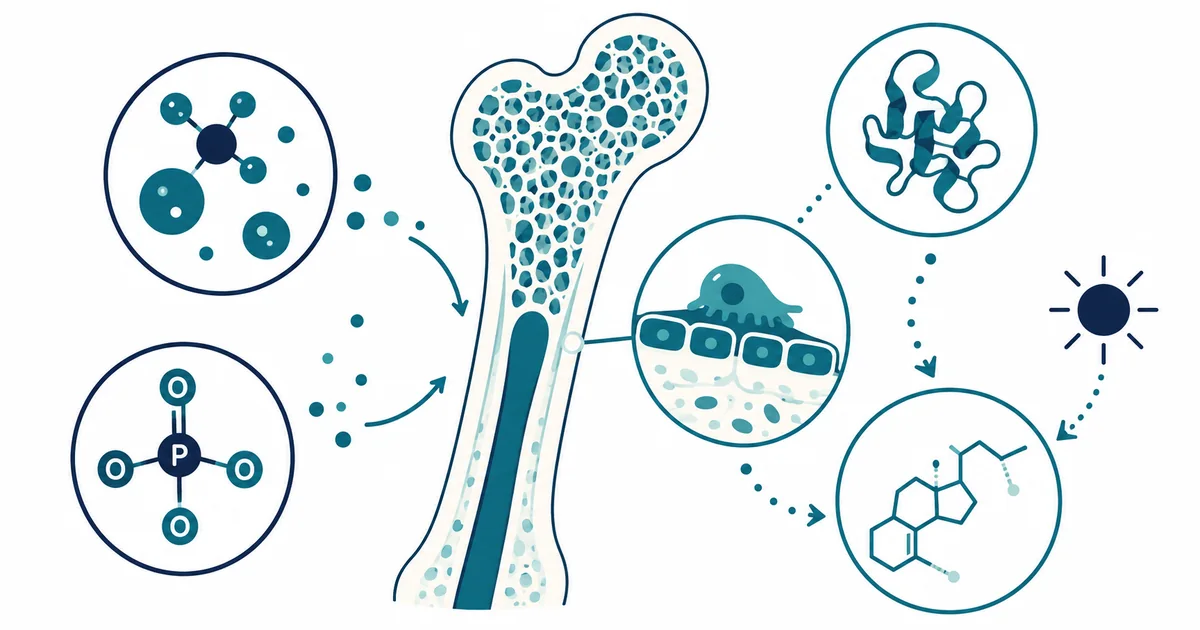
A bone profile — also called a bone chemistry panel or calcium and bone profile — is a group of blood tests that together give an overview of bone metabolism and the mineral systems that regulate it. Bones are dynamic tissues constantly being built and broken down, and this process depends on precise regulation of calcium, phosphate, parathyroid hormone (PTH), and vitamin D. When any of these are disrupted, both bone health and broader physiological systems can be affected. The bone profile is ordered to investigate symptoms such as bone pain or fractures, to monitor patients with known metabolic bone disease, and to screen for conditions affecting calcium regulation.
Key Takeaways
- Calcium is the primary mineral in bone and is tightly regulated; abnormal calcium (hypercalcaemia or hypocalcaemia) has important clinical effects beyond bone.
- Adjusted (corrected) calcium accounts for albumin levels and gives a more accurate measure of physiologically active calcium.
- Alkaline phosphatase (ALP) is an enzyme elevated in bone turnover and liver disease; the source must be differentiated using clinical context or isoenzymes.
- Phosphate works closely with calcium in bone mineralisation; its regulation involves PTH, vitamin D, and FGF-23.
- Vitamin D (25-hydroxyvitamin D) is often measured separately but is central to calcium and bone metabolism.
Calcium
Calcium is the most abundant mineral in the body and is essential for bone structure, nerve transmission, muscle contraction, and coagulation. Approximately 99% of body calcium is stored in bone; the remaining 1% circulates in blood. Of the circulating calcium, about 40% is bound to albumin (biologically inactive), 10% forms complexes with ions such as phosphate and citrate (inactive), and 50% is free ionised calcium (the biologically active form). Typical reference range for total calcium: 2.2–2.6 mmol/L. Because bound calcium depends on albumin concentration, low albumin (e.g., in malnutrition or liver disease) will cause a low total calcium even if physiologically active ionised calcium is normal. For this reason, laboratories report an adjusted (corrected) calcium that compensates for the albumin level. Ionised calcium can also be measured directly on a blood gas analyser.
Hypercalcaemia (high calcium) most commonly results from primary hyperparathyroidism (excess PTH secretion, usually from a parathyroid adenoma) or malignancy (bone metastases or PTH-related peptide secretion by tumours). Other causes include vitamin D toxicity, sarcoidosis, and immobilisation. Hypocalcaemia (low calcium) most commonly results from vitamin D deficiency or hypoparathyroidism; it can also occur in chronic kidney disease (impaired vitamin D activation) and hypomagnesaemia.
Phosphate
Phosphate works with calcium in bone mineralisation and is also essential for cellular energy metabolism (ATP) and acid-base regulation. Like calcium, phosphate is regulated by PTH, vitamin D, and fibroblast growth factor 23 (FGF-23). Typical reference range: 0.8–1.5 mmol/L. Hyperphosphataemia (high phosphate) is most commonly seen in chronic kidney disease (impaired excretion) and is a marker of CKD progression. Hypophosphataemia (low phosphate) occurs in malnutrition, malabsorption, vitamin D deficiency, and primary hyperparathyroidism (PTH promotes phosphate excretion). Severe hypophosphataemia can cause muscle weakness and impaired bone mineralisation (osteomalacia).
Alkaline Phosphatase (ALP)
Alkaline phosphatase is an enzyme found in several tissues including bone, liver, bile ducts, kidney, and placenta. In a bone profile, ALP is a marker of osteoblast activity — bone-building cells release ALP when actively synthesising new bone matrix. Elevated ALP in a bone profile context can indicate increased bone turnover in Paget’s disease of bone (focal excessive bone remodelling), bone metastases, osteomalacia or rickets (softened bone due to vitamin D deficiency), healing fractures, and primary hyperparathyroidism. However, ALP is also elevated in liver and biliary disease (cholestasis, hepatitis). When ALP is raised, differentiating the source (bone vs. liver) requires clinical context, GGT measurement (GGT is elevated in liver disease but not bone disease), or bone-specific ALP isoenzyme testing. Typical reference range: 30–130 U/L (age- and sex-dependent; higher in children and adolescents due to normal bone growth).
Vitamin D (25-Hydroxyvitamin D)
Vitamin D is a fat-soluble vitamin and hormone precursor. It is obtained from sun exposure (skin synthesis from cholesterol) and dietary sources (oily fish, fortified foods, supplements). The liver converts vitamin D to 25-hydroxyvitamin D (25-OHD, calcidiol) — the main circulating and storage form, measured in blood tests. The kidneys then convert 25-OHD to the biologically active form, 1,25-dihydroxyvitamin D (calcitriol), which promotes calcium and phosphate absorption from the gut. Vitamin D deficiency is extremely common worldwide and causes rickets in children (failure of bone mineralisation during growth) and osteomalacia in adults (softening of existing bone). It is also associated with osteoporosis, muscle weakness, and impaired immune function. Typical reference ranges: deficiency below 25 nmol/L; insufficiency 25–50 nmol/L; sufficient above 50 nmol/L (UK guidance from NICE).
Common Bone Conditions Assessed by the Bone Profile
Osteoporosis is characterised by reduced bone density and increased fracture risk; bone profile tests are often normal in osteoporosis (DEXA scanning, not blood tests, is used to diagnose it), but they are ordered to exclude secondary causes. Osteomalacia and rickets result from inadequate mineralisation due to vitamin D or phosphate deficiency — bone profile typically shows low/normal calcium, low phosphate, elevated ALP, low vitamin D. Primary hyperparathyroidism causes high calcium, low phosphate, elevated ALP, and high PTH. Paget’s disease causes markedly elevated ALP with normal calcium and phosphate. Bone metastases may cause elevated calcium (hypercalcaemia of malignancy) and elevated ALP.
References
- National Library of Medicine. Calcium Blood Test. MedlinePlus. https://medlineplus.gov/lab-tests/calcium-blood-test/
- NHS. Vitamin D. https://www.nhs.uk/conditions/vitamins-and-minerals/vitamin-d/
- NICE. Vitamin D: supplement use in specific population groups. Public Health Guideline PH56. 2014.
- NICE Guideline NG187. Osteoporosis: assessing the risk of fragility fracture. 2012 (updated 2017).
- Kanis JA et al. European guidance for the diagnosis and management of osteoporosis in postmenopausal women. Osteoporosis International. 2019;30(1):3–44.
More questions answered
What does the bone profile blood test actually measure?
The bone profile blood test measures a group of biochemical markers related to calcium and bone-mineral metabolism. The test is usually performed on serum or plasma, although the exact sample and method depend on the laboratory. The result is often interpreted alongside calcium, albumin, phosphate, alkaline phosphatase and related tests because one measurement rarely answers every clinical question. The practical takeaway is to read the value in the context of the laboratory report rather than treating it as a stand-alone diagnosis.
Do I need to fast before the bone profile blood test?
Fasting is not automatically required just because this test has been requested. Preparation depends on the exact test request, so the laboratory or healthcare service should provide any fasting or timing instructions. If other tests are ordered at the same time, their preparation requirements may determine how the blood sample should be collected. The safest approach is to follow the collection instructions given for the specific appointment rather than fasting unnecessarily.
What can affect the bone profile blood test result besides disease?
A bone profile blood test result can be influenced by age, liver activity, kidney function, hormones, vitamin D and bone turnover. Some effects happen before analysis, which laboratories describe as pre-analytical factors, while others reflect genuine biological variation. The laboratory may also consider sample quality and analytical limitations before releasing a result. This is why an unexpected value may need context or repeat testing rather than an immediate conclusion.
Why might the bone profile blood test be repeated?
A repeat test can help show whether a result is persistent, changing or likely to have been affected by a temporary factor. Comparing results over time creates a trend, which can be more informative than one isolated measurement. Repetition may also be needed when the sample was unsuitable or when the first result requires confirmation according to laboratory procedure. A healthcare professional decides whether repeat testing is clinically useful.
Why can the reference range for the bone profile blood test differ between laboratories?
Laboratories may use different reference intervals because their analysers, reagents, calibration systems and reference populations are not always identical. Even when two laboratories measure the same analyte, differences in assay methods can produce different reporting ranges or units. The correct comparison is therefore the range printed on the same laboratory report as the result. A range found online should not replace the laboratory’s own interval.
How is the bone profile blood test measured in the laboratory?
The sample is first checked to make sure it is suitable for testing, then the serum or plasma is processed according to the laboratory method. Measurement is typically performed using a clinical chemistry analyser, with quality-control material used to check that the analytical system is behaving as expected. Results that trigger laboratory rules may be reviewed, repeated or investigated before release. This controlled quality process helps reduce avoidable analytical errors.
Can the bone profile blood test diagnose a condition by itself?
No single bone profile blood test result should usually be treated as a complete diagnosis on its own. The test can support assessment of mineral balance and selected bone, liver or endocrine questions, but the meaning depends on clinical context, other laboratory findings and sometimes imaging or examination. An abnormal value can have more than one explanation, while a value inside the reference interval does not exclude every condition. Personal interpretation should therefore be discussed with a healthcare professional.
Calcium vs Ionised Calcium Blood Test Explained