

A “biomedical science degree” does not mean exactly the same career pathway in the UK and the US. In the UK, biomedical science is closely connected with the regulated profession of biomedical scientist, while in the US the clinical laboratory profession is more commonly organised around titles such as medical laboratory scientist (MLS) or clinical laboratory scientist, with programme accreditation, certification and state requirements that follow a different structure.
The key mistake is assuming that the same degree title automatically produces the same professional eligibility on both sides of the Atlantic.
UK vs US pathways at a glance
| Feature | United Kingdom | United States |
|---|---|---|
| Common clinical laboratory professional title | Biomedical scientist | Medical laboratory scientist (MLS) or clinical laboratory scientist, depending on employer/state terminology |
| Degree pathway | Biomedical science degrees can form part of the professional route when the programme meets the required accreditation/approval structure | Clinical laboratory training is commonly delivered through medical laboratory science programmes; a general biomedical science degree may be broader and may not include all MLS clinical competencies |
| Key education/accreditation body | IBMS accredits biomedical science degree programmes used in the standard professional route | NAACLS accredits medical laboratory science and related clinical laboratory programmes |
| Professional credential | HCPC registration is required to use the protected title biomedical scientist | Certification such as ASCP Board of Certification is widely used, while legal licensure requirements vary by state |
| Clinical competence component | Registration Training Portfolio / approved clinical training route in the standard IBMS pathway | MLS curricula include clinical laboratory competencies and practical training; certification routes can vary |
| Are qualifications automatically portable? | No. Cross-border recognition requires individual assessment against the destination country’s requirements | |
What does biomedical science mean in the UK?
In the UK, biomedical science is both an academic field and the educational foundation for a regulated healthcare profession. The professional title biomedical scientist is protected by law and regulated by the HCPC.
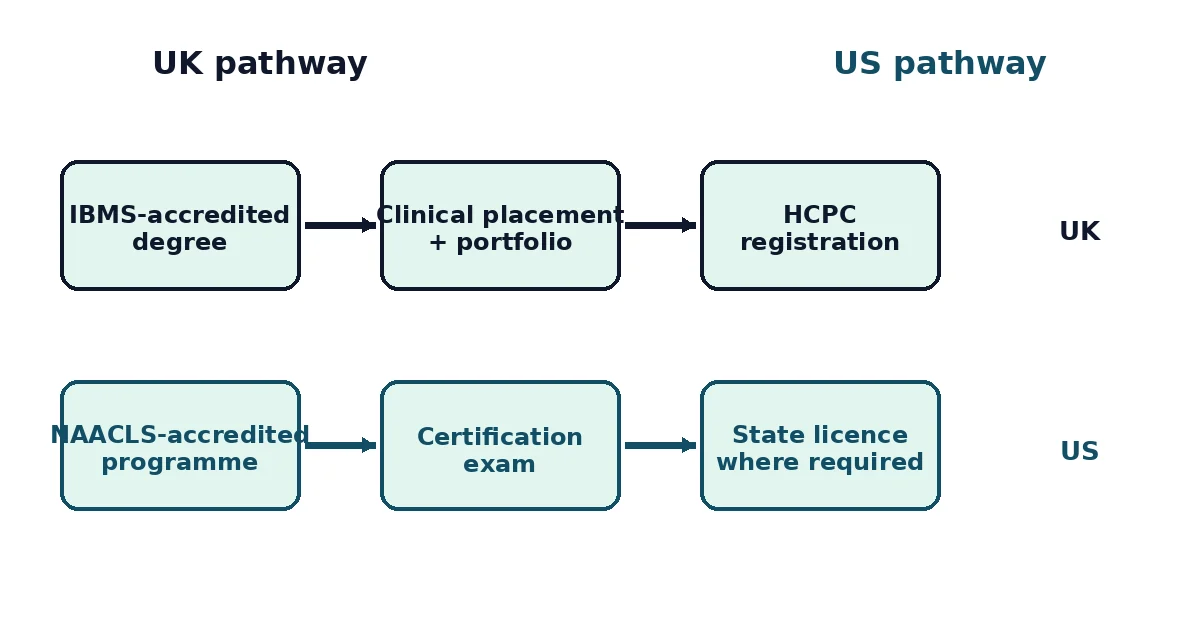
An IBMS Accredited biomedical science degree is designed to cover the academic content needed for the standard registration pathway. The candidate also needs to demonstrate practical competence through an approved route, commonly the IBMS Registration Training Portfolio completed in an approved training laboratory.
After the relevant academic and competence requirements are completed, the candidate can apply for HCPC registration through the appropriate route. Only then should the degree title and professional title be treated as the same thing.
This distinction matters because a UK university can offer a degree called biomedical science that is not necessarily structured as the direct professional registration route.
What does biomedical science mean in the US?
In the United States, “biomedical science” is often a broader academic label covering human biology, molecular science, disease mechanisms, research preparation or pre-professional study.
It does not automatically mean that the graduate has completed the specialised clinical laboratory curriculum required for medical laboratory scientist practice. US clinical laboratory training is more commonly delivered through medical laboratory science or clinical laboratory science programmes.
NAACLS-accredited MLS curricula cover major diagnostic disciplines and the pre-analytical, analytical and post-analytical competencies needed for entry-level laboratory practice.
What is the UK route to becoming a biomedical scientist?
For the conventional UK route, students should look for an IBMS Accredited biomedical science degree and understand whether the programme includes the appropriate clinical placement and Registration Training Portfolio opportunity.
Some integrated programmes allow the academic degree and portfolio training to be completed in a coordinated pathway. Other accredited degrees provide the academic component but require the graduate to secure an approved training position after university to complete the portfolio.
Graduates from non-accredited degrees may need an IBMS degree assessment and supplementary education before proceeding through the relevant UK route.
The final statutory step is HCPC registration. The IBMS supports education and competence assessment, but HCPC is the regulator that maintains the professional register.
What is the US route to becoming a medical laboratory scientist?
A common US route is completion of a NAACLS-accredited MLS programme followed by eligibility for a recognised certification examination such as an ASCP Board of Certification route.
ASCP publishes multiple eligibility routes, so requirements depend on education, clinical training and experience. Legal licensure requirements vary by state, and employers may also specify certification requirements, so applicants should check the rules for the state where they plan to work.
Is a UK biomedical science degree equivalent to a US MLS degree?
Not automatically. Even an excellent UK biomedical science programme and a strong US MLS programme may organise academic and clinical training differently.
A UK IBMS Accredited course is designed around the UK professional pathway, while a NAACLS-accredited US MLS programme is designed around US clinical laboratory education standards. The curriculum may overlap substantially in areas such as chemistry, haematology, microbiology, immunology and transfusion science, but professional recognition is jurisdiction-specific.
A graduate moving countries may need credential evaluation, proof of coursework, clinical training records, certification or other evidence. The destination regulator, licensing authority, certification body or employer makes that decision.
Do not assume that the word “accredited” in one country creates automatic professional eligibility in another.
Can a US biomedical science graduate become a UK biomedical scientist?
Potentially, but a US biomedical science degree is not automatically treated as an IBMS Accredited UK degree. Education and professional training must be assessed against the relevant UK route.
HCPC has an international application route for eligible overseas-trained professionals, while IBMS guidance covers degree assessment where academic qualifications do not match the standard accredited pathway. A general biomedical sciences degree may therefore present a different evidence profile from a dedicated MLS programme.
Can a UK biomedical scientist work in the US?
Potentially, but UK HCPC registration does not automatically grant US certification or state licensure. A UK-trained applicant may need to document education and clinical experience for a US certification route and meet any requirements in the state where they plan to work.
ASCP publishes several eligibility routes, and state rules are not uniform. Professional mobility is therefore an assessment process, not an automatic conversion.
Which degree should you choose if you want to work in a hospital laboratory?
Choose backwards from the professional role and country where you want to work. In the UK, prioritise an IBMS Accredited programme and understand how clinical competence training is completed; in the US, look closely at NAACLS-accredited MLS programmes and the certification or licensure requirements relevant to the intended state.
A broad biomedical science degree can still be valuable for research, postgraduate study and other science careers. The key question is whether the curriculum is designed for the professional credential you actually want.
Why does terminology cause so much confusion?
The labels are not globally standardised. The UK gives “biomedical scientist” a protected regulatory meaning, while the US more often uses MLS or CLS for comparable clinical laboratory roles and may use “biomedical sciences” for a broader academic subject.
Always identify the country, regulator, programme accreditation and exact job title before comparing pathways.
The key difference to remember
– UK: biomedical science can be part of the professional route to the HCPC-regulated biomedical scientist title, with IBMS accreditation and clinical competence training central to the standard pathway.
– US: clinical laboratory practice is more commonly structured around medical laboratory science programmes, certification and state-specific requirements; a generic biomedical sciences degree does not automatically equal MLS training.
The science overlaps. The professional pathways do not automatically transfer.
Related reading
For the academic subject itself, see [LINK: biomedical-science-degree-explained — what a biomedical science degree covers]. For the clinical laboratory profession across different systems, see [LINK: what-is-a-medical-laboratory-scientist — what a medical laboratory scientist does].
FAQ
Is a biomedical science degree the same in the UK and US?
No. In the UK, biomedical science can form part of the structured pathway towards the HCPC-regulated biomedical scientist profession. In the US, a degree called biomedical sciences is often broader and may focus on research, human biology or pre-professional study rather than clinical laboratory competencies. US clinical laboratory training is more commonly delivered through medical laboratory science programmes. Always check programme accreditation and professional outcomes rather than relying on the degree title alone.
What is the US equivalent of a UK biomedical scientist?
The closest common US professional terminology is often medical laboratory scientist (MLS) or clinical laboratory scientist (CLS), depending on the state and employer. The jobs overlap strongly in diagnostic laboratory science, but the education, certification and legal frameworks are different. There is no automatic one-to-one credential conversion. Anyone moving countries should check the destination system’s certification and licensing requirements.
Does a US biomedical science degree qualify you for HCPC registration?
Not automatically. An overseas biomedical science degree has to be considered within the appropriate UK registration pathway and against the required standards. HCPC provides an international application route, while IBMS may also have relevant degree-assessment guidance depending on the applicant’s circumstances. The exact outcome depends on the person’s education and professional training, not the title printed on the degree certificate.
Does a UK IBMS Accredited degree qualify you to work as an MLS in the US?
Not automatically. IBMS accreditation is designed for the UK professional pathway and does not itself grant US certification or state licensure. A UK graduate may need credential evaluation and may need to meet a certification body’s MLS eligibility route plus any state-specific legal requirements. The destination employer or licensing authority may also request evidence of clinical training. Professional mobility therefore requires individual assessment.
What is NAACLS and how is it different from IBMS?
NAACLS accredits clinical laboratory education programmes in the United States, including medical laboratory scientist programmes. IBMS is the UK professional body that accredits biomedical science degrees and supports the education and competence route associated with HCPC registration. Both relate to laboratory education quality, but they operate in different professional systems. Accreditation by one should not be assumed to replace the other’s requirements.
Should I study biomedical science or medical laboratory science in the US?
It depends on your career goal. If your aim is specifically to work as a medical laboratory scientist, a programme designed around MLS competencies and recognised accreditation is usually the more direct professional route. A biomedical sciences degree may be better suited to broader research, postgraduate or pre-professional goals depending on the curriculum. Check the programme’s published graduate outcomes and the certification/licensure requirements for the state where you want to work.
Educational purposes only. Not medical advice.
### FACT-CHECK SOURCES — NOT FOR PUBLICATION
– Institute of Biomedical Science, *IBMS Accredited BSc degree with registration portfolio*.
– Institute of Biomedical Science, *Non IBMS Accredited BSc degree*.
– Health and Care Professions Council, *Standards of proficiency — biomedical scientists* and international registration guidance.
– National Accrediting Agency for Clinical Laboratory Sciences (NAACLS), *Standards for Accredited Programs — Medical Laboratory Scientist* (2024 standards).
– ASCP Board of Certification, current MLS eligibility route documentation.
—
# SITEWIDE SEO IMPLEMENTATION NOTES
## Recommended publishing order
1. Serum vs Plasma — broadest laboratory comparison and strongest natural internal-link support.
2. HbA1c vs Fasting Glucose — strong patient/search intent with two established supporting explainers.
3. ESR vs CRP — directly converts two low-click generic inflammation pages into a narrower comparison target.
4. IBMS vs HCPC — strong student/career intent and high trust potential using official UK bodies.
5. Biomedical Scientist vs Lab Technician — expands the site’s proven role-comparison pattern.
6. Ferritin vs Serum Iron — captures a common interpretation confusion without trying to outrank broad “ferritin” head terms.
7. UK vs US Biomedical Science Degree Pathways — narrower international career intent; useful for topical authority and cross-border searches.
## On-page template for all seven
– One H1 only.
– Put the 1–2 sentence direct answer immediately below the H1.
– Place the comparison table above the first long explanatory section.
– Use descriptive H2s that naturally contain the compared entities.
– Keep the FAQ visible in the article body; do not create hidden FAQ content only for schema.
– Add the two specified internal links contextually in the body and again in Related Reading only if that does not feel repetitive.
– Add 2–4 additional contextual internal links to relevant glossary or hub pages where genuinely useful, but avoid turning every paragraph into an internal-link block.
– Use the established 1200×630 LabWise featured-image system and descriptive alt text.
– Show a clear author, published/updated date and educational disclaimer.
– Include authoritative external references where they materially improve trust, especially on regulatory pages.
## Suggested cross-linking between the seven new comparison pages
– Serum vs Plasma → HbA1c vs Fasting Glucose when discussing specimen type only if natural.
– HbA1c vs Fasting Glucose → Serum vs Plasma when explaining whole blood versus plasma collection.
– ESR vs CRP → Ferritin vs Serum Iron when explaining acute-phase effects on ferritin.
– Ferritin vs Serum Iron → ESR vs CRP when discussing inflammation as a confounder.
– IBMS vs HCPC ↔ Biomedical Scientist vs Lab Technician.
– IBMS vs HCPC ↔ UK vs US Biomedical Science Degree Pathways.
– Biomedical Scientist vs Lab Technician ↔ UK vs US Biomedical Science Degree Pathways where international title differences are relevant.
## Keyword strategy
Do not optimise these pages by repeating the exact primary keyword mechanically. Use the primary comparison naturally in the H1, introduction, one H2 or table context, SEO title and meta description. Expand semantic coverage through the entities readers need to understand the distinction: specimen matrices, clotting, fasting, glycated haemoglobin, acute-phase response, registration, accreditation, protected titles, clinical competence and certification.
No search-volume figures are included in this file because no verified keyword-volume dataset was supplied. The strategy is based on the site’s GSC observation in the brief: comparison intent is currently converting more effectively than broad single-topic explainers.
## Search-intent protection / cannibalisation rules
– Existing single-topic articles remain the deep explainer pages.
– New comparison pages own the difference / vs / which-measures-what intent.
– Avoid rewriting existing explainers around the same “X vs Y” keyword after these pages go live.
– Link from each single-topic explainer to the relevant comparison page with a natural “X vs Y” anchor where useful.
– Do not canonicalise the comparison article to either single-topic page; these are distinct intents.
– If GSC later shows one comparison page cannibalising another, check query-level overlap before changing titles or URLs.
## Title-tag guidance
Keep the primary phrase near the beginning, but prioritise natural CTR language over adding extra modifiers. The recommended titles in this file deliberately use “What’s the Difference?”, “Key Differences” or the audience qualifier rather than keyword stuffing terms such as “Explained 2026 Guide”.
## Meta-description guidance
Meta descriptions are written as click-oriented summaries, not ranking claims. Google may rewrite them. Keep them factual, avoid “best”, “definitive” or diagnosis-style promises, and make the comparison benefit obvious within the first sentence.
## Structured data guidance
Use the site’s normal Article and BreadcrumbList schema. FAQ rich results are restricted in Google Search and should not be treated as the main SEO reason to create FAQs. If the site outputs FAQPage schema, only mark up questions and answers that are actually visible to users and avoid duplicating schema from multiple plugins.
## E-E-A-T / trust implementation
For the medical laboratory comparisons:
– Display James’s biomedical science author credential consistently.
– Link to Editorial Policy, References Policy and Medical Disclaimer.
– Prefer sources such as WHO, NIDDK, MedlinePlus and recognised professional guidance.
– Avoid personal test interpretation and diagnostic thresholds unless the article specifically needs them and the criteria are sourced and jurisdictionally appropriate.
For the career/regulatory comparisons:
– Link directly to IBMS and HCPC official guidance where readers may need current eligibility decisions.
– Clearly distinguish professional-body membership from statutory registration.
– For US content, distinguish NAACLS programme accreditation, ASCP certification and state licensure rather than presenting them as one system.
– Add “last reviewed” updates when regulatory content is rechecked.
## Measurement plan after publishing
Track each new URL separately in Google Search Console for at least these query families:
– `[term A] vs [term B]`
– `difference between [term A] and [term B]`
– `[term A] or [term B]`
– `[term A] compared with [term B]`
– Role/regulatory variants such as `do I need`, `which body`, `registered`, `accredited`, `degree` and `career`.
Watch impressions, average position, CTR and query spread, not clicks alone. If a page reaches positions roughly 6–15 with impressions but weak CTR, test the title and meta description before rewriting the article. If a page has no meaningful impressions after indexing and recrawl, reassess the query target and internal-link strength rather than adding filler content.
## Final publication QA checklist
– [ ] All seven URLs use the suggested comparison-focused slugs unless an existing URL creates a conflict.
– [ ] One H1 per page.
– [ ] Direct answer visible above the fold.
– [ ] Real HTML comparison table present.
– [ ] At least six FAQs, each visible to users.
– [ ] Two required internal links inserted.
– [ ] No accidental self-diagnosis or personal-result advice.
– [ ] UK English spelling preserved.
– [ ] Regulatory facts checked against current IBMS/HCPC pages before publication.
– [ ] US pathway language checked against current NAACLS/ASCP/state requirements where a specific claim is added.
– [ ] Featured image set to 1200×630 WebP and compressed according to the existing LabWise image standard.
– [ ] Author attribution and readable published/updated date shown.
– [ ] Canonical points to the new page itself.
– [ ] Page included in XML sitemap and indexable.
– [ ] Relevant single-topic pages link back to the comparison page.
– [ ] Mobile table is horizontally scrollable or responsive without breaking layout.
– [ ] Educational disclaimer visible at the end.