

Ferritin and serum iron both relate to iron, but they measure different parts of iron metabolism. Ferritin is mainly used as a marker of stored iron, while serum iron measures iron circulating in the blood at the time the sample is taken, much of it carried by transferrin.
This is why one result cannot simply replace the other and why laboratories often report iron studies as a group rather than relying on a single number.
Ferritin vs serum iron at a glance
| Feature | Ferritin | Serum Iron |
|---|---|---|
| What it represents | A protein that stores iron; blood ferritin is commonly used as an indirect marker of iron stores | Iron circulating in serum at the time of collection |
| Biological time frame | More related to the body’s stored iron reserve | A more variable snapshot of circulating iron |
| Major limitation | Ferritin can rise with inflammation, infection, liver disease and other conditions | Serum iron varies with time of day, recent intake and other short-term influences |
| Used alone? | Often useful but still interpreted in context | Usually more informative when combined with transferrin/TIBC and transferrin saturation |
| Same as haemoglobin? | No | No |
| Can they disagree? | Yes. Different results may reflect different aspects of iron metabolism or confounding factors | |
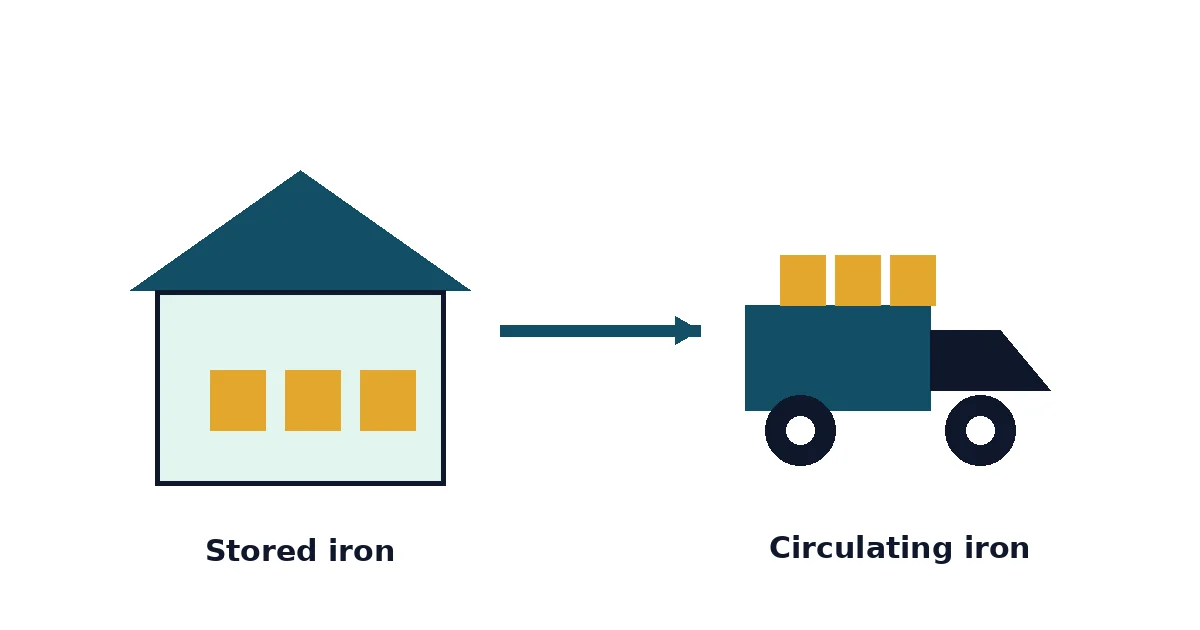
What does ferritin measure?
Ferritin is a protein that stores iron inside cells. A small amount circulates in blood, and the serum ferritin concentration is widely used as a laboratory marker related to the body’s iron stores.
When iron reserves fall, ferritin can become low. This makes ferritin particularly useful when clinicians are investigating possible iron depletion.
However, ferritin has an important limitation: it is also an acute-phase reactant. Inflammation, infection, liver disease and other conditions can increase ferritin independently of whether iron stores are genuinely high.
That means a ferritin value cannot always be read as a direct fuel gauge for the body’s iron reserve. The clinical context and other laboratory markers matter.
What does serum iron measure?
A serum iron test measures the amount of iron circulating in the serum at the time of collection. Most circulating iron is transported bound to transferrin, a protein that carries iron through the blood.
Serum iron is much more dynamic than ferritin. It can vary during the day and can be influenced by recent iron intake, supplements and other biological factors.
Because it is a snapshot, serum iron alone is a relatively incomplete description of the body’s overall iron status. A low serum iron result does not automatically mean that the person’s iron stores are depleted, and a normal result does not prove that stores are adequate.
This is why clinicians frequently interpret serum iron alongside other components of an iron study.
What else is included in iron studies?
An iron studies panel can include ferritin, serum iron, transferrin or total iron-binding capacity and transferrin saturation. The exact panel varies between laboratories and healthcare systems.
Transferrin provides information about the main iron-transport protein in blood. Total iron-binding capacity is another way of assessing iron-binding capacity, depending on the laboratory method. Transferrin saturation relates the circulating iron to the available transport capacity and can add context that serum iron alone cannot provide.
A full blood count is also frequently relevant because haemoglobin, mean cell volume and other red-cell indices show how iron availability may be affecting red-cell production.
The key principle is that iron metabolism is a system. No single laboratory value tells the whole story.
Why can ferritin be normal or high when serum iron is low?
One reason is inflammation. During an inflammatory response, iron handling changes and ferritin can rise as part of the acute-phase response, while circulating serum iron may fall.
That pattern is different from a simple situation in which the body has progressively depleted its stored iron. It is one reason clinicians may review CRP or other inflammatory information when ferritin does not fit the rest of the iron profile.
Liver conditions and other biological factors can also influence ferritin. The correct interpretation depends on the complete pattern rather than trying to decide iron status from one normal-range flag.
Why does serum iron fluctuate more?
Serum iron reflects circulating iron at a particular time, so it is more sensitive to short-term biological variation. MedlinePlus notes that serum iron levels vary during the day and may be higher in the morning.
Recent iron intake and supplements can also affect the measurement, which is why some services provide specific preparation instructions. The exact collection protocol should come from the laboratory or healthcare service performing the test.
Ferritin is generally less affected by these short-term changes, but its own major confounder is inflammation. Each test therefore has a different weakness.
Is ferritin the same as iron in haemoglobin?
No. Ferritin stores iron, whereas haemoglobin is the oxygen-carrying protein inside red blood cells that contains iron as part of its structure.
A person can move through stages of iron depletion before haemoglobin becomes clearly reduced. That is why iron-store measurements and the full blood count can provide different information.
It is also possible to have anaemia for causes unrelated to iron deficiency. A low haemoglobin result should not automatically be translated into “low ferritin” or “low serum iron”.
Which result is more useful for iron deficiency?
Ferritin is commonly a key test for assessing iron stores, but “which is better?” is still too simple. Ferritin can be misleading when inflammation or other conditions raise it, while serum iron is too variable to serve as a complete picture on its own.
Clinicians often look at the pattern across several tests. That can include ferritin, serum iron, transferrin saturation, the full blood count and markers of inflammation depending on the situation.
For readers, the safest takeaway is not to diagnose iron deficiency from a single isolated result. A healthcare professional can decide whether the pattern requires further investigation.
Do you need to fast for ferritin or serum iron?
Preparation varies by laboratory and by which tests are being collected together. Some services may request morning collection or fasting for parts of an iron-study panel, particularly because serum iron can be affected by recent intake and time of day.
Ferritin itself is a different measurement, but the preparation instructions may be written for the whole panel rather than for one test in isolation.
Do not stop medicines or supplements simply to influence a blood test unless a healthcare professional specifically instructs you to do so. Follow the collection service’s instructions exactly.
The key difference to remember
– Ferritin: mainly reflects stored iron, but can rise with inflammation.
– Serum iron: measures circulating iron at one time point and is more variable.
Neither is the same as haemoglobin, and neither should be interpreted without the wider iron profile when the clinical question is complex.
Related reading
For the storage marker in more detail, see [LINK: ferritin-blood-test-explained — how the ferritin blood test works]. For the wider panel, see [LINK: iron-studies-explained — how iron studies are interpreted together].
FAQ
Is ferritin the same as serum iron?
No. Ferritin is a storage protein and serum ferritin is commonly used as a marker related to iron stores. Serum iron measures iron circulating in the blood at the time of the test. They describe different parts of iron metabolism, so one value cannot simply be substituted for the other.
Can ferritin be normal when serum iron is low?
Yes. Ferritin and serum iron can move differently because they are influenced by different biological processes. Inflammation can raise ferritin while circulating iron falls, and serum iron also varies with time and recent intake. A normal ferritin therefore does not automatically explain an isolated low serum iron result. Clinicians usually review the wider iron profile and clinical context.
Which test shows iron stores better?
Ferritin is generally the more direct laboratory marker related to the body’s stored iron reserve. However, ferritin can rise as an acute-phase reactant, making interpretation more difficult when inflammation or other conditions are present. Serum iron is a more variable snapshot of circulating iron. The most useful interpretation often comes from combining ferritin with other iron-study results.
Why is serum iron not usually interpreted alone?
Serum iron varies over the day and can be influenced by short-term factors such as recent iron intake. It also does not show how much transport capacity is available or how much iron is stored. Tests such as transferrin, TIBC or transferrin saturation add information about iron transport and binding. A full iron-study pattern is therefore more informative than one isolated serum iron number.
Can inflammation make ferritin high?
Yes. Ferritin is an acute-phase reactant and can increase during inflammation or infection, as well as in several other conditions. A raised ferritin therefore does not automatically mean that the body’s iron stores are excessive. Clinicians interpret it with other laboratory results and the clinical picture. Personal results should be discussed with a healthcare professional.
Is low haemoglobin the same as low iron?
No. Haemoglobin can be low for many reasons, and iron deficiency is only one possibility. Ferritin and other iron studies provide different information about iron storage and transport. Likewise, iron stores can decline before haemoglobin necessarily becomes clearly low. The complete blood count and iron profile need to be interpreted together in context.
Educational purposes only. Not medical advice.
### FACT-CHECK SOURCES — NOT FOR PUBLICATION
– MedlinePlus, *Ferritin Blood Test*.
– MedlinePlus, *Iron Tests*.
– MedlinePlus Medical Encyclopedia, *Serum iron test*.
—
## 7) UK vs US Biomedical Science Degree Pathways